

Constitutional Peacebuilding
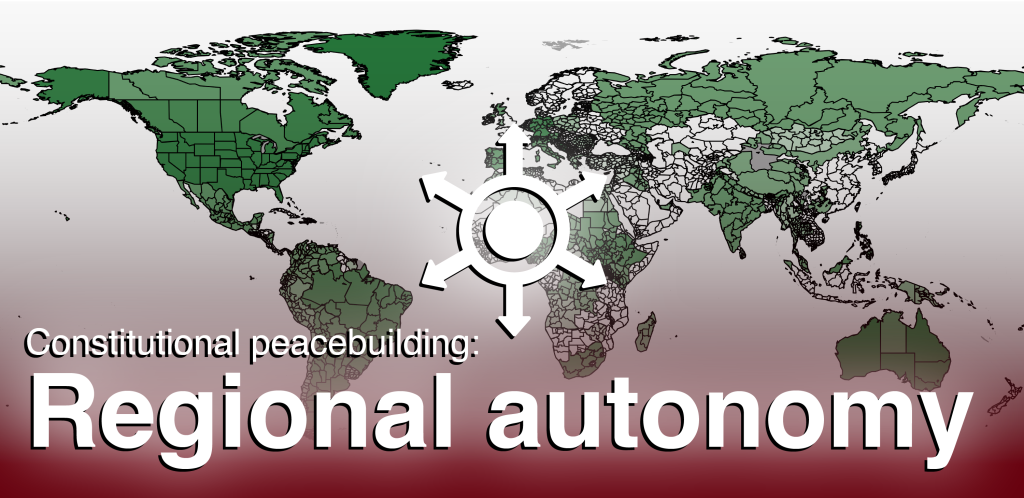
Ethno-nationalist conflict poses grave risks to peace and stability, as illustrated by ongoing violence in Israel/Palestine, Myanmar, and Ethiopia. In response, prominent scholars and policymakers advocate in favor of minorities’ inclusion through governmental power-sharing and regional autonomy. While these institutions are widely credited with helping end civil wars, their design and implementation remain contested, as they may conflict with democratic norms or inadvertently fuel new grievances. Addressing these challenges, I study the effects of constitutional power-sharing and regional autonomy on ethno-nationalist conflict and democratic quality. In contrast to existing work I purposefully examine the benefits of these institutions for included minorities together with their unintended “side-effects” on other parts of the citizenry. Most notably, this refers to minorities that remain excluded and the majority community whose influence is diminished by these institutions. Moreover, I examine how these institutions shape mass attitudes among ordinary citizens, not just conflict outcomes. This approach, which incorporates globally representative survey data, enables a more comprehensive assessment of institutional peacebuilding and its societal consequences.
Exclusionary Nationalism
As illustrated by the destabilizing policies taken by Russia under Putin, China under Xi Jinping, and the US under Trump, exclusionary nationalism can undermine democratic institutions, fuel ethnic discrimination, and harm global political and economic integration. Thereby, the global rise of exclusionary nationalism critically weakens some of the most important foundations of international security. Addressing these challenges, my second line of research analyzes the causes and consequences of exclusionary nationalism. Innovating over previous work that focused on rational incentives of governments or minorities’ struggle for emancipation, I highlight the importance of exclusionary nationalist ideology in shaping conflict and democracy. I examine the impact of exclusionary nationalism at different spatial levels, including at a subnational scale, and bring to bear novel global data, enabling me to shed new light on the causes and consequences of exclusionary nationalism. A first part of this project examines dominant nationalism, which aims for dominance at the central government level and is consequently often propagated by movements representing demographic majorities (e.g. Hindu nationalists in India, white supremacists in the US). A second part turns to the subnational level, focusing on regionalist and separatist movements that engage in subnational majoritarianism.
Please click on the icons above to learn more about these projects and their associated publications and databases.
 Andreas Juon