Dominant Nationalist Movements Database (DNM)
Global data on dominance-claiming nationalist movements, their ideology, and their political influence, 1816-present.
The Dominant Nationalist Movements (DNM) Dataset is an original global database I am collecting together with Aya Abdelrahman, leading a team of country experts and research assistants. The DNM identifies nationalist movements worldwide that demand political dominance for a specific ethnic, religious, linguistic, or racial group at the expense of other groups in the same state. It tracks their ideological platforms, the specific demands they make against targeted outgroups, their government access, and (for an extended historical sample) their imperialist ambitions. The database is collected in two phases that differ in temporal coverage, geographic scope, and coding depth.
Why a new dataset on dominant nationalism
Existing cross-national datasets on ethnic politics overwhelmingly focus on the mobilization of non-dominant groups: minorities seeking inclusion, autonomy, or independence. Datasets such as the Ethnic Power Relations (EPR) family and EPR-Organizations track politically relevant ethnic groups and their organizations' demands for inclusion or parity. No existing dataset systematically documents the organizations that mobilize in the opposite direction: movements claiming that a specific group (typically, but not always, a demographic majority) should hold dominant or exclusive political power, to the disadvantage of other groups in the same state.
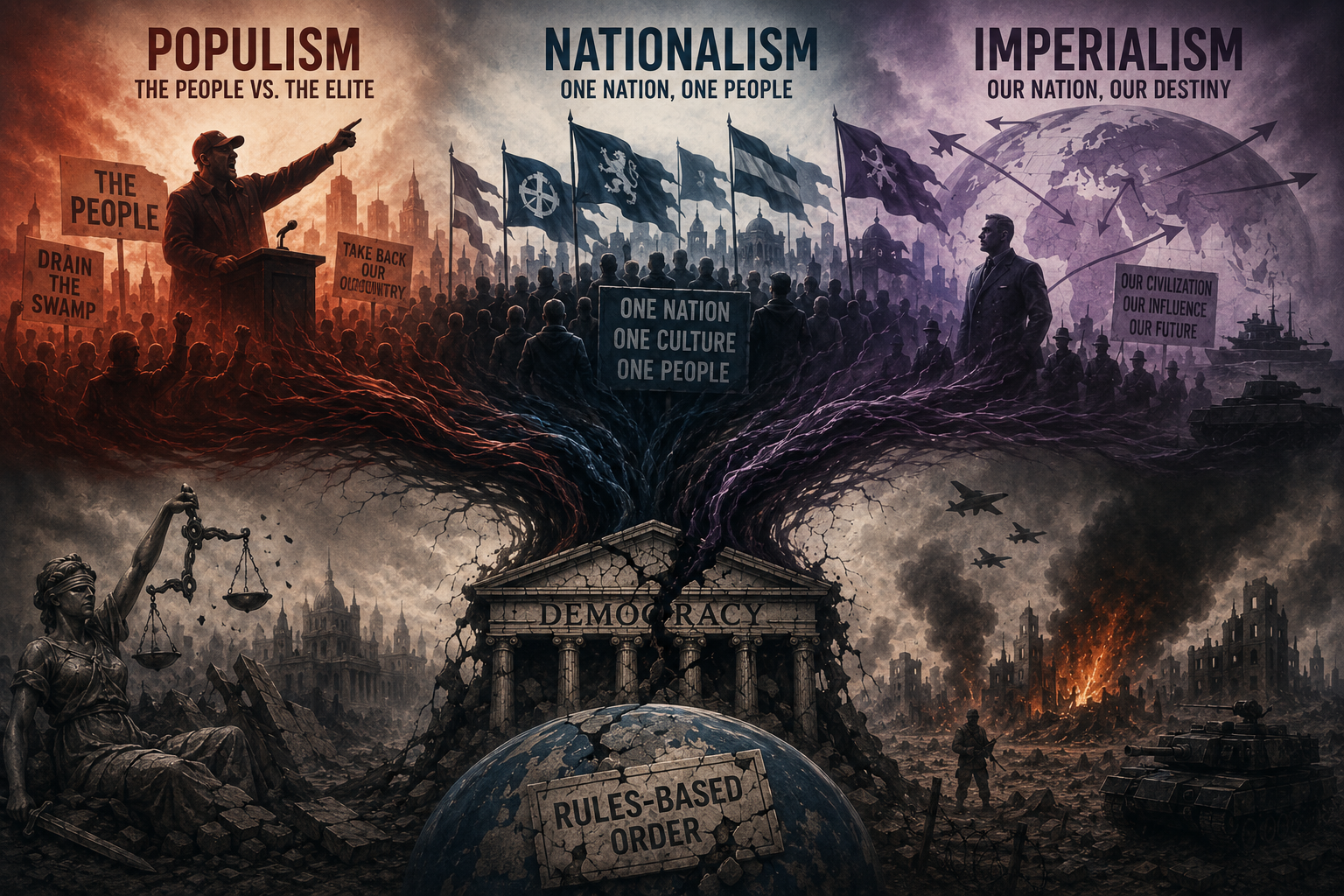
This is a significant gap. Dominant nationalists have played central roles in some of the most consequential episodes of ethnic conflict and democratic backsliding of the past century: from Rwanda's Hutu Power movement, which derailed a power-sharing agreement and enabled the 1994 genocide, to Sinhala nationalist parties in Sri Lanka, which repeatedly blocked accommodation of Tamil minorities, to the Hindu nationalist BJP in India and Fidesz in Hungary, whose governments have constrained minority rights and democratic competition alike. Assessing whether these movements are a systematic driver of civil war, democratic erosion, and international conflict (rather than isolated exceptions) requires cross-national data tracking their presence, ideology, and political influence over time.
Phase 1: Detailed coding (90 multiethnic states, 1946–2023)
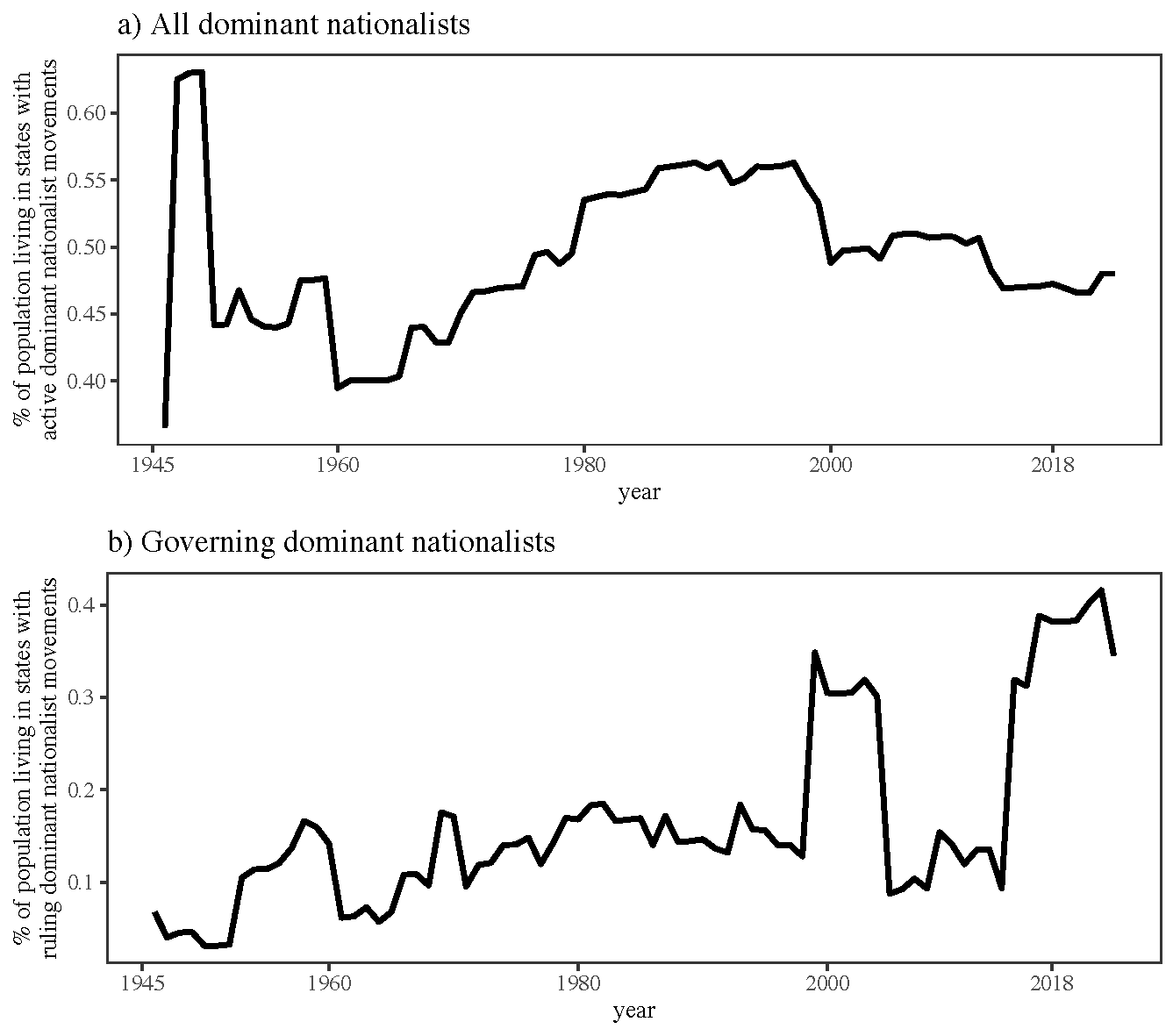
The first phase covers a representative sample of 90 multiethnic states in North America, Eurasia, and Africa, selected from all states of reasonable size with a clear ethnic or cultural majority group. This phase provides the most detailed coding, including time-varying indicators for each movement's demands, mobilization modes, and government access, as well as organization-level information on constituent parties, militias, and other formal organizations.
Identification of dominant nationalist movements
A movement enters the DNM sample if it is constituted by one or more politically relevant organizations that simultaneously satisfy three conditions:
- A claim to represent a specific ethnic, cultural, religious, linguistic, or racial identity group, through consistent public appeals or patterns of recruitment and support.
- Demands for political dominance for this group, ranging from dominant representation in government (tolerating token minority inclusion) to full monopoly rule (exclusion of all other groups), directed at the central government and to the disadvantage of other groups in the same state.
- Minimal political relevance, evidenced by at least one of: government inclusion; obtaining at least 1% of votes or one parliamentary seat in a national election; national-level membership of at least 10,000; or demonstrated mass support despite being banned from elections.
Movements demanding mere proportional representation or parity are explicitly excluded, as are movements that target recent immigrants rather than resident ethnic minorities, pursue exclusively subnational dominance, or restrict their demands to economic or cultural rather than political spheres.
Country experts consulted historical dictionaries, qualitative studies, and existing data on parties (V-Party), ethnic organizations (EPR-Organizations), pro-government militias (PGMD), and rebel/communal organizations (UCDP) to identify movements meeting these criteria in each state. Coding decisions are documented in text-based format for transparency.
Demand types
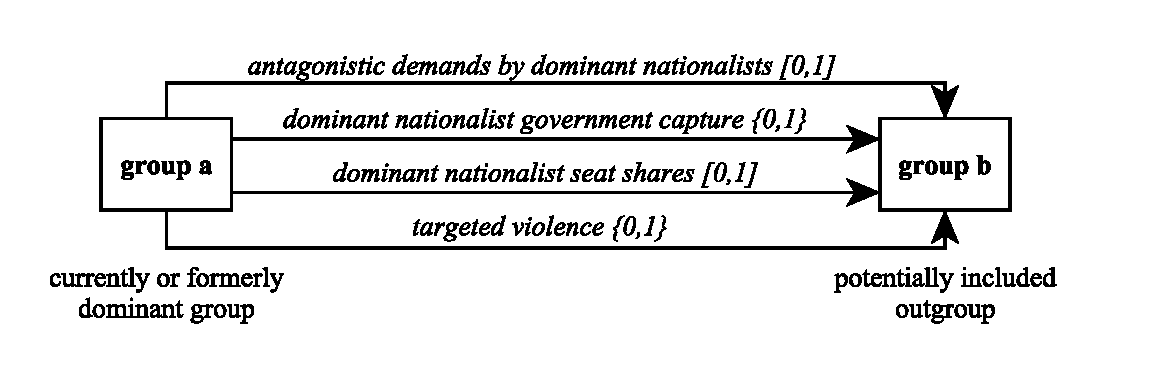
For each identified movement, the DNM codes, on a time-period basis, whether its platform includes the following exclusionary demands directed at specific outgroups:
- Dominance in government: the movement's group holds dominant power, but tolerates limited minority representation (e.g., South Africa's Afrikaner nationalists under apartheid).
- Monopoly rule: complete exclusion of all other groups from executive power (e.g., Rwanda's Hutu Power movement).
- Citizenship/voting rights restrictions: demanding that specific groups be excluded from citizenship or the vote (e.g., Sinhala nationalist parties in Sri Lanka, which campaigned to strip Indian Tamils of citizenship).
- Assimilation: demanding that minority groups adopt the dominant group's language, religion, or culture (e.g., interwar Polish nationalists targeting Belarusians and Ukrainians).
- Expulsion: demanding the physical removal of specific groups from state territory (e.g., religious Zionist organizations advocating removal of Arab inhabitants from occupied territories).
- Extermination: demanding the killing of members of targeted groups (e.g., Hutu Power in Rwanda, 1993–1994).
Demands are coded on the basis of publicly documented positions in secondary literature, not on whether they were actually implemented. When demands are directed against specific outgroups, these are recorded at the dyad level. This enables directed analyses of which groups face which movements.
Mobilization modes
For each movement and time period, the DNM also records how dominant nationalists mobilize:
- Electoral participation (national elections)
- Anti-government protests (1,000+ participants)
- Identity-targeted protests (1,000+ participants, against which groups)
- Anti-government violence (25+ deaths per year)
- Identity-targeted violence (25+ deaths per year, against which groups)
Ideological justification
Each movement's underlying ideological rationale for the dominant group's entitlement to power is coded from secondary literature. The DNM distinguishes between justifications based on: indigeneity or prior occupation; a special civilizational or religious mission; claims of group superiority; past glory or traditional rule; past heroic struggles or victimization; ongoing internal or external threats; and the need to rectify historical injustices. Multiple justifications can apply simultaneously, and shifts over time are recorded.
Government access
For each year, the DNM records whether any organization belonging to a movement held executive power, distinguishing between dominant control (the head of government is a movement member and opposition is wholly excluded or tokenized), senior coalition partnership, junior coalition partnership, and exclusion from government. When movements are excluded, the dataset additionally records whether the government openly supports, tacitly supports, opposes, or is indifferent to the movement.
Organization-level coding
Each movement may consist of multiple formal organizations: political parties (reaching at least 1% of the vote or one parliamentary seat), armed militias or rebel groups (engaged in political violence with 25+ deaths in at least one year), and non-party government executives. These organizations are coded separately with their own periods of activity, mobilization modes, and government access indicators. Researchers can thereby track internal movement dynamics and factional variation.
Phase 2: Extended historical coverage (202 states, 1816–2023)
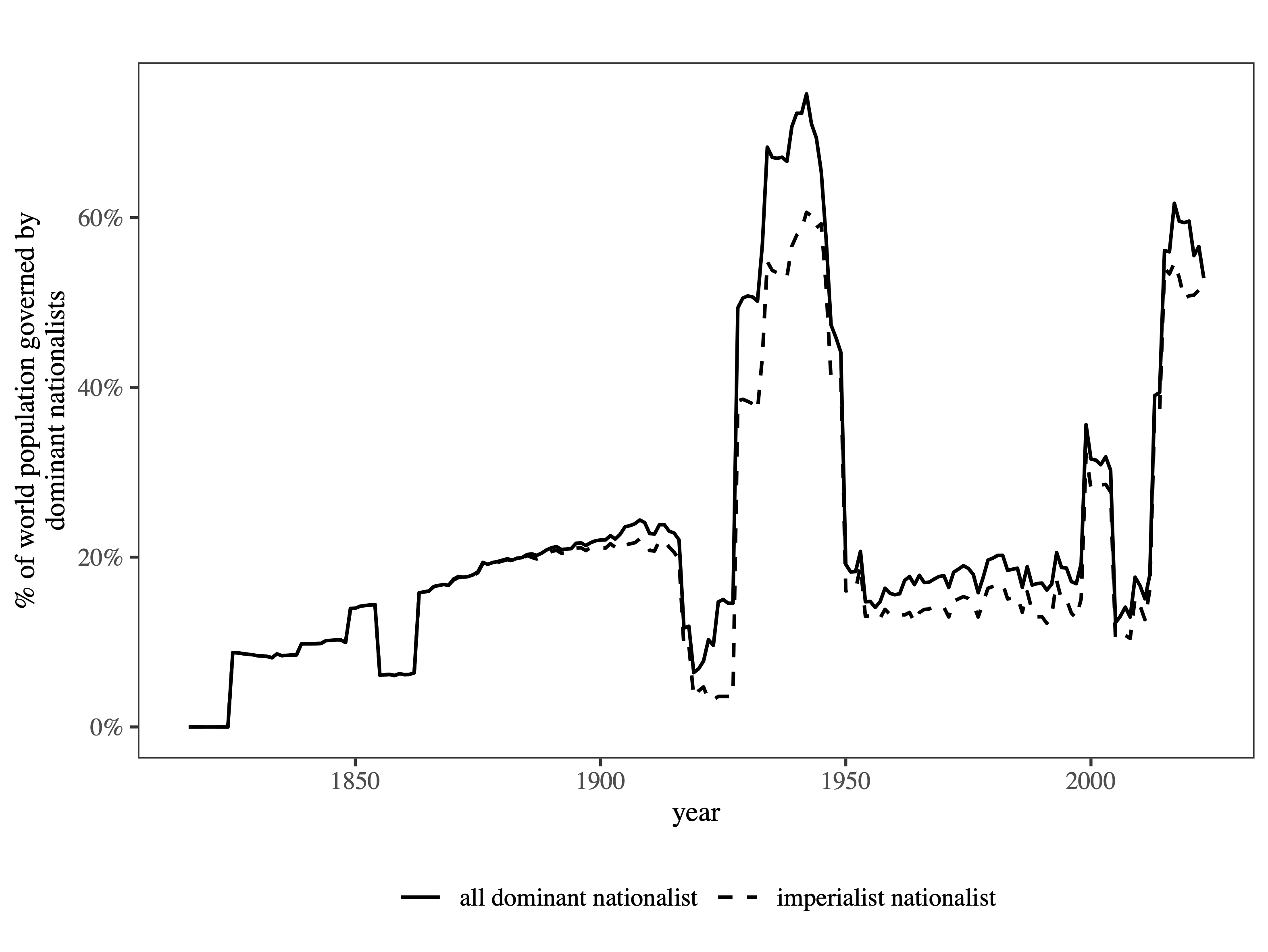
The second phase extends the DNM's coverage to all remaining independent states and back to 1816, producing a sample of 202 sovereign states over more than two centuries. For this extended sample, coding is more limited: it covers the identification of dominant nationalist movements, a narrower set of ideology indicators recorded in the first year of each movement's existence, and auxiliary government access coding using connections between identified movements and chief executives as identified by V-Dem.
A key addition in the extended sample is the identification of imperialist nationalists as a subset of dominant nationalists. Imperialist nationalist governments are those whose ideological justifications draw on at least one of three core imperialist narratives (appeals to past national greatness or golden ages, claims of a special civilizational or religious mission, or assertions of national superiority) and that articulate political claims crossing international borders, evidenced by territorial claims against other states, assertions of authority over transnational identity groups, or explicit portrayal of other states as historic enemies or current threats.
Use in published research
A first version of the DNM has been used across five publications. In the dataset's main presentation paper, the Phase 1 data are used to show that groups targeted by dominant nationalist demands face a substantially elevated civil war onset risk, comparable in magnitude to the effect of actual government exclusion, with secessionism as the primary mediating pathway (Juon & Cederman, Dominant Nationalism and Civil War, conditionally accepted). Using the same Phase 1 data, the DNM enables the first systematic cross-national test of whether ethnic accommodation generates a dominant nationalist backlash, finding instead a consistent long-run moderating effect of minority inclusion (Abdelrahman, Cederman & Juon, Backlash or Moderation?, first draft). The Phase 1 data are also used to disentangle the democratic effects of dominant nationalism from those of populism, finding that dominant nationalism (not populism per se) is the primary systematic driver of recent democratic backsliding (Juon & Bochsler, Nationalism, Populism, and Democracy, under review). Drawing on the Phase 2 extended coverage, the DNM is used to show that dominant nationalist governments (and especially imperialist nationalist governments) significantly increase the risk of initiating interstate conflict, with effects operating both through classic irredentist mechanisms and independently of them (Juon, Abdelrahman & Cederman, A Place in the Sun, first draft). Finally, the extended Phase 2 data are used to introduce a typology of nationalist rule ranging from monistic to dominant to imperialist nationalism and to demonstrate that imperialist nationalism is self-undermining: as state power grows, imperialist regimes face sharply elevated risks of regime collapse, coups, foreign occupation, and civil war (Cederman & Juon, Beyond Congruence, in preparation).