Ethnic Power Relations Database
The EPR Dataset Family provides data on ethnic groups' access to state power, their settlement patterns, links to rebel organizations, transborder ethnic kin relations, and intraethnic cleavages.
The Ethnic Power Relations (EPR) Dataset Family is a long-running collective data infrastructure developed at ETH Zurich's International Conflict Research group. It is the field's most comprehensive source of cross-national data on ethnic groups' political status, geographic settlement, organizational mobilization, and transnational ties. During my time as Postdoctoral Fellow at ETH Zurich, I helped supervise the 2023 update of the EPR family, extending its temporal coverage through 2023 and enabling the most recent assessments of global trends in ethnic inclusion and exclusion.
The EPR dataset family
The EPR family consists of several integrated datasets that together cover the political, geographic, organizational, and demographic dimensions of ethnicity in comparative politics:
EPR Core identifies all politically relevant ethnic groups worldwide from 1946 to 2023 and codes the degree to which their representatives held executive-level state power in each year. The power access categories range from total control of the government, through senior and junior coalition partnership and regional autonomy, to powerlessness and active political discrimination. With over 800 groups coded across more than 150 countries, EPR Core is the main basis for cross-national research on ethnic inclusion, exclusion, and their consequences for conflict and democracy.
Geo-EPR extends the core dataset with geospatial information, assigning each group to one of six settlement patterns and providing digital map polygons describing their geographic locations. This enables researchers to study the spatial dimensions of ethnic politics (including the overlap between ethnic settlement areas and administrative or conflict boundaries) and to connect EPR groups to geographically referenced data from other sources.
ACD2EPR is a docking dataset that links armed conflicts in the UCDP/PRIO Armed Conflict Dataset to the politically relevant ethnic groups in EPR, establishing which ethnic communities are involved in which conflicts as rebel constituents or government-aligned groups.
EPR-TEK (Transnational Ethnic Kin) documents politically relevant ethnic groups that inhabit multiple countries, capturing which groups have ethnic kin across international borders and in which states. This enables research on irredentism, kin-state intervention, and the role of transnational ethnic ties in interstate conflict.
EPR-ED (Ethnic Dimensions) codes the linguistic, religious, and racial cleavages that characterize and internally divide the politically relevant ethnic groups in the EPR core. It thereby allows researchers to disaggregate group identities and study which dimension of ethnicity is most politically salient in a given context.
EPR-Organizations codes the formal political organizations (parties, rebel groups, and civil society organizations) that represent EPR groups and articulate their political demands, enabling research on the organizational bases of ethnic mobilization.
My contribution and the 2023 update
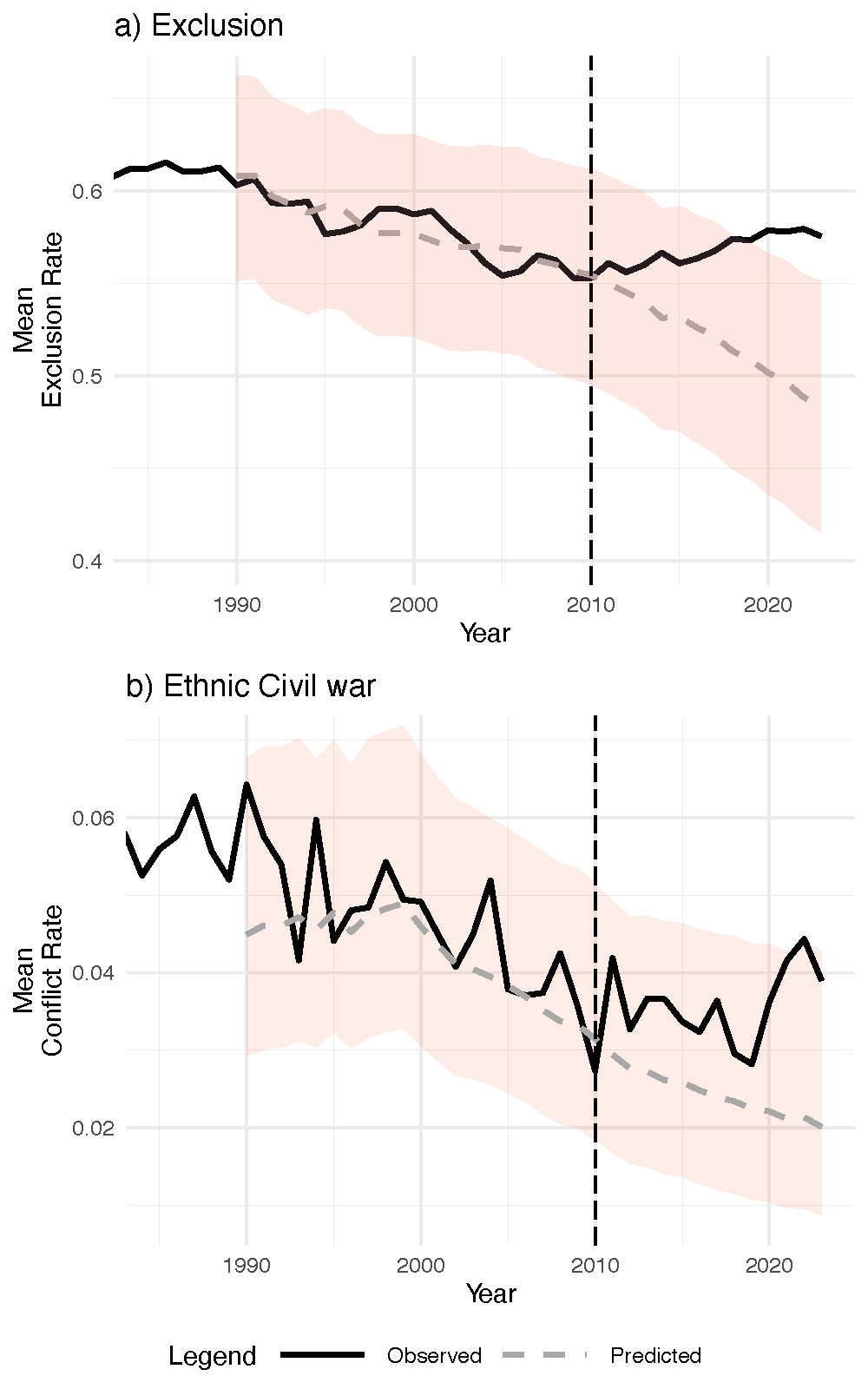
The 2023 update, which I helped supervise, extended the EPR family's temporal coverage by two years, adding data for 2022 and 2023. This was important for capturing the most recent shift in global trends of ethnic inclusion and exclusion. The updated data reveal that, after decades of gradual decline in political exclusion following the Cold War, the percentage of ethnic groups excluded from executive power has been rising since approximately 2010. By 2023, 65 previously included groups had experienced political downgrading. This reversal closely tracks the growing political influence of nationalist and illiberal actors around the world; as the updated EPR data make clear, this trend has had concrete consequences: rising exclusion has driven increasing rates of ethnic civil war and interstate conflict, reversing the post-Cold War peace dividend (Cederman, Galano Toro, Girardin, Juon & Wucherpfenig 2026, The Return of Nationalist Geopolitics).
Role in my research
In addition to the 2023 update, EPR underpins a much wider body of my empirical work. EPR groups serve as the primary unit of analysis across my research on constitutional power-sharing and its consequences: the Constitutional Power-Sharing Dataset (CPSD) links its institutional indicators to EPR groups, enabling group-level measurement of who benefits from and who is excluded by formal power-sharing provisions. EPR's government access coding is also the standard measure of de facto power-sharing in my empirical analyses, against which constitutionally mandated power-sharing (as measured by CPSD) is consistently compared and validated. EPR group-years constitute the analytic sample for cross-national analyses of civil war risk, democratic quality, minority grievances, and the moderating or escalating effects of power-sharing arrangements across my conflict and democracy research.