Is Central and Eastern Europe sliding back into authoritarianism, or are developments in the region more nuanced than sensationalistic headlines based on prominent cases suggest? In this paper, we take a systematic look at democratic quality across all 19 CEE democracies from 1990 to 2016 and find that real-world developments are considerably more varied than the narratives centered on Hungary and Poland might suggest. While democratic erosion is genuine in specific countries and as regards specific democratic dimensions, the region as a whole has not undergone the kind of broad democratic reversal that some of the most pessimistic commentary implies.
The democratic backsliding in Hungary under Orbán, Poland under PiS, and Serbia under Vučić has understandably drawn enormous attention, from scholars and policymakers alike. But most existing accounts of democratic decline in CEE rely on qualitative assessments of a small number of cases, often selected precisely because they are the most worrying. This raises an obvious question: are these countries representative of a wider regional trend, or are they exceptions? Without a systematic, data-driven assessment covering the full set of CEE democracies, there is no rigorous way to answer that question. In this article, we set out to fill that gap.
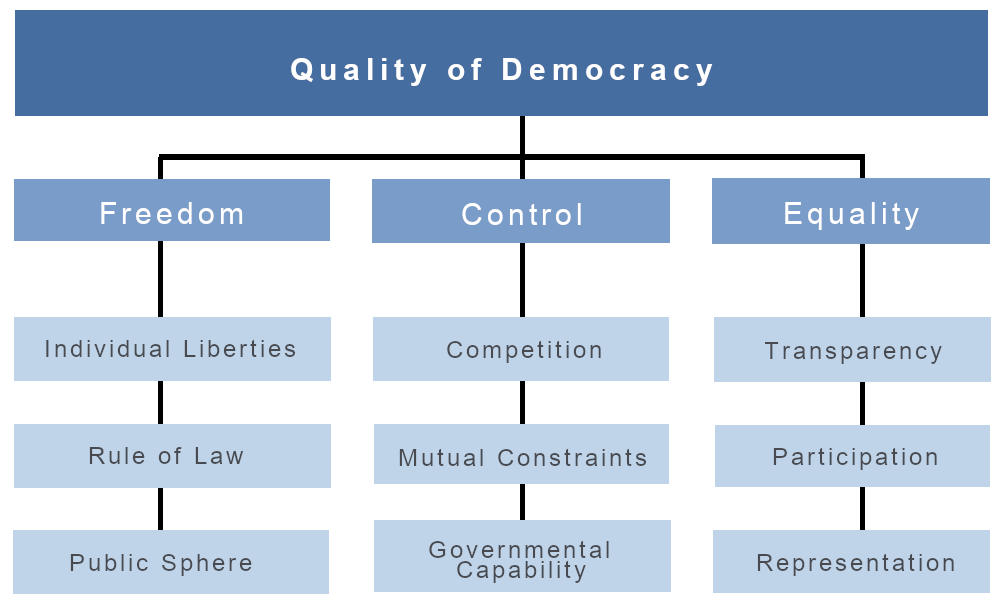
Our analysis draws on the Democracy Barometer, a dataset built from objective indicators and survey data rather than expert assessments of democracy alone. This dataset, whose update preceding this publication I coordinated, allows us to track nine democratic functions across all 19 CEE democracies from 1990 to 2016. These functions include the rule of law, political competition, transparency, individual liberties, and the quality of the public sphere (figure 1). With these outcome variables in hand, we then examine three potential drivers of democratic change in the region: populist parties in government, EU accession dynamics, and the 2008 financial crisis.
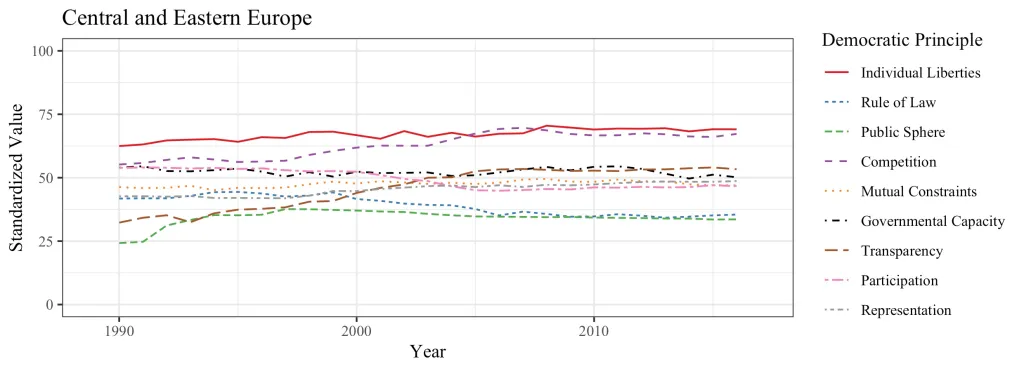
Looking at the overarching regional picture first, we find that the democratic gains of the 1990s, especially as regards political competition, transparency, and the public sphere, largely stalled after 2000 but did not reverse across the region as a whole. The most persistent weakness we identify throughout the entire period is in rule of law and the public sphere. However, these persistent shortcomings are not a story of democratic collapse; instead, they represent a story of democratic progress that ran out of steam, combined with serious but geographically uneven deterioration of specific dimensions of democracy in a small number of countries.
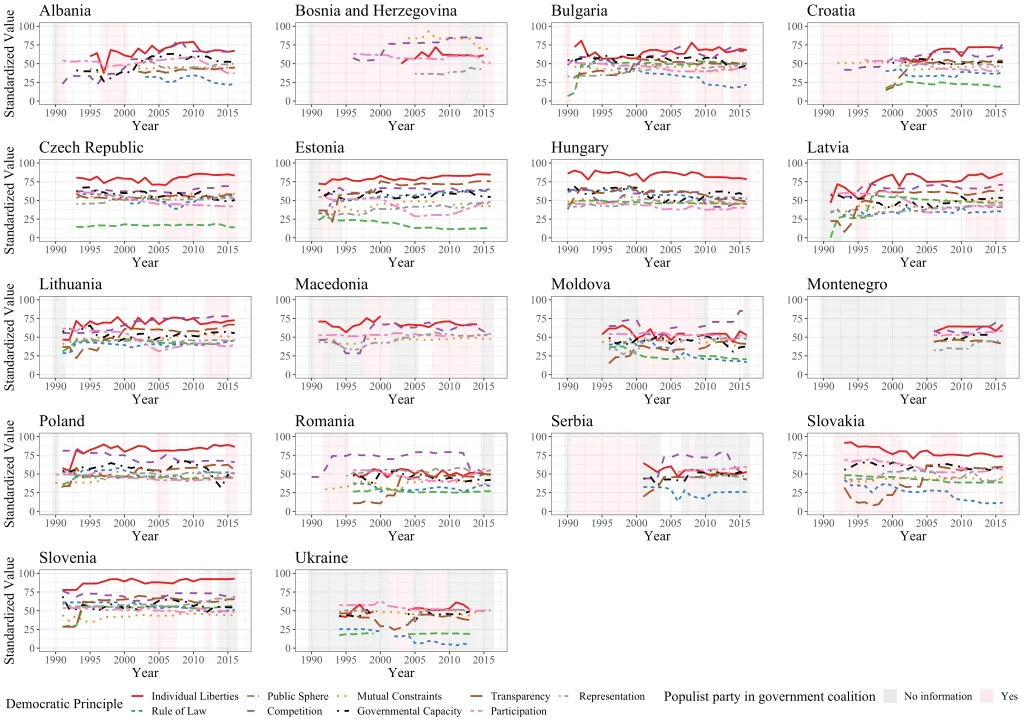
When we drill down to individual countries, democratic erosion becomes more visible and concerning, but remains mostly confined to specific democratic dimensions in specific places. For instance, we find that the rule of law deteriorated in Slovakia, Ukraine, and Bulgaria beginning around 2000, in Romania around 2012, and in Albania after 2011. Political competition narrowed sharply in Hungary in 2010, Romania in 2012, and Serbia in 2014. These are real democratic setbacks, but based on our systematic data, they do not appear to be representative of a uniform regional crisis, at least by 2016.
On the role of populist governments, we find that their impact is real but highly context-dependent (figure 2). For example, we find that the rule of law declined after populists took office in Moldova in 2001, the Czech Republic and Slovakia in 2006, and Bulgaria in 2009. Transparency eroded under Sanader in Croatia, Fico in Slovakia, Orbán in Hungary, and Szydło in Poland. Political competition contracted sharply in Hungary after 2010, in Bulgaria in 2009 and 2015, and in Moldova in 2001. At the same time, many populist governments left no or only limited detectable democratic marks at all, indicating that populism in government is neither sufficient nor necessary to produce backsliding in the CEE region.
As regards the European Union's role, our findings indicate that EU conditionality demonstrably works before membership. Our data trace democratic advances in individual liberties, rule of law, party finance transparency, and press freedom, which cluster in the years just before countries take major EU integration steps. But, echoing other research on this matter, we find that EU membership provides no effective protection against post-accession backsliding, as exemplified by the experiences of Hungary, Slovakia, Bulgaria, and the Czech Republic. Article 7 proceedings and related enforcement mechanisms have proven too weak, too slow, and too politically fraught to act as a genuine deterrent against backsliding initiated by determined illiberal actors.
The 2008 financial crisis, by contrast, does not emerge as a systematic driver of the broader pattern in our data. We observe some country-level effects, most visibly in Bulgaria, Hungary, and Bosnia, but no region-wide democratic reversal followed the economic shock.
Overall, our findings indicate that the widespread perception of a deep and generalized democratic crisis in CEE is overstated, at least through 2016. Genuine cases of serious erosion exist and deserve attention, but they are not representative of the region as a whole. For the EU in particular, the evidence points toward a straightforward prescription: conditionality before accession is the most effective democratic lever available, and post-accession enforcement mechanisms need substantial strengthening if the Union is to remain a meaningful guarantor of democratic standards among its members.
For detailed findings and methodology, please see the article linked in the header above.