Power-sharing and the quality of democracy
Systematic analysis on the democratic effects of populists, depending on their ideological leaning, and differentiating between different aspects of democracy.
Does institutionalized power-sharing improve the quality of democracy, or does it risk undermining fundamental aspects thereof? That is one of the most fundamental questions in research on power-sharing and on nation-building in divided places more broadly. However, this question has long been controversially contested, primarily on the basis of individual case observations and theories focusing on specific aspects of democracy in isolation. In this article, we offer the first systematic, cross-national assessment of whether power-sharing arrangements advance or undermine the quality of democracy across its multiple dimensions. Our results are more nuanced than suggested by either side of the indeterminate pro/con debate that long dominated this field of research.
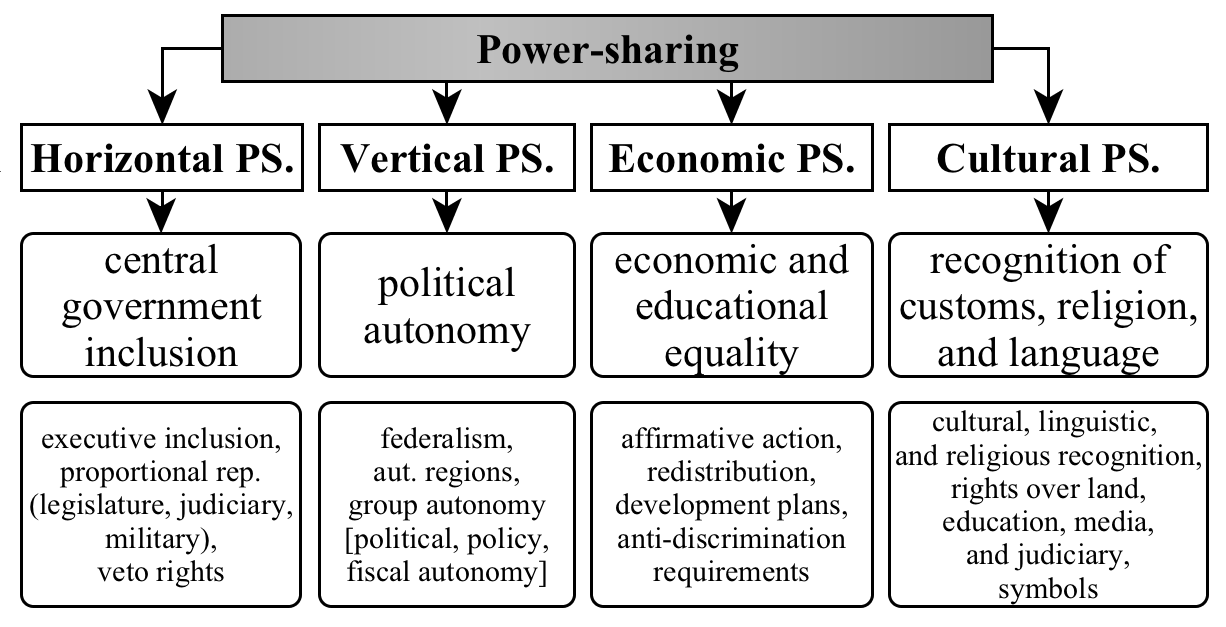
We depart from the observation that power-sharing (the institutionalized inclusion of multiple groups in government) has attracted sustained attention as a strategy for managing deeply divided societies. Building on influential theoretical and case accounts, cross-national research has increasingly documented power-sharing's role in facilitating democratic transitions and preventing renewed civil conflict. But transitions to peace and the establishment of nominally democratic regimes do not equate high democratic quality, let alone across all distinct dimensions thereof. Indeed, prior theory-driven work has raised a set of troubling possibilities: that cartel-like, elitist power-sharing governments demobilize citizens and reduce meaningful participation; that group-based rights on which power-sharing often rests infringe on individual liberties; that the mutual veto logic of power-sharing produces political immobilism and degraded government capability. These critiques are theoretically well-founded but have so far not been subject to a systematic, cross-national assessment.
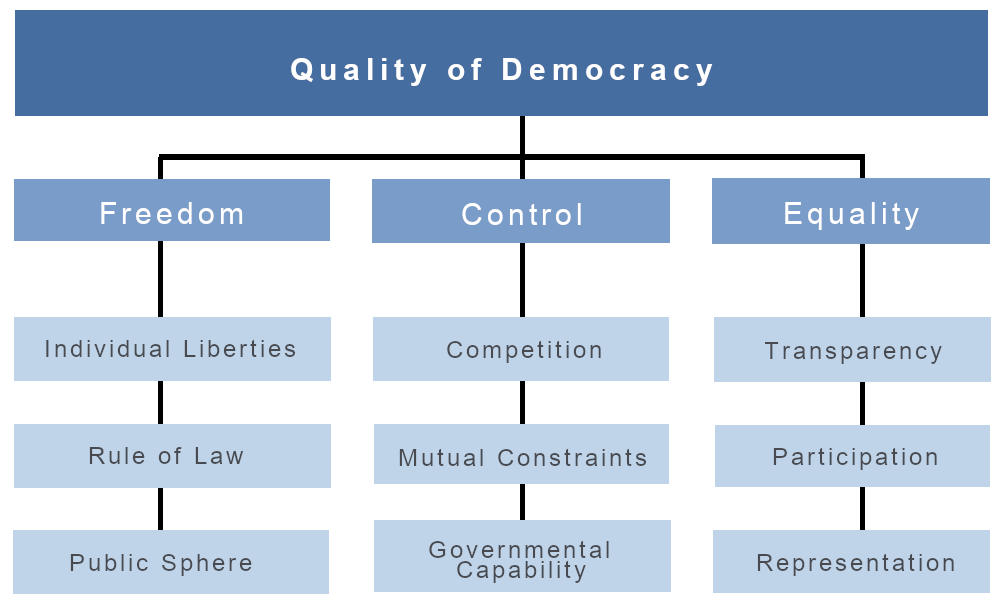
We fill that gap by drawing on the Democracy Barometer (a dataset covering 70 democracies from 1990 to 2016 with objective and survey-based indicators spanning multiple dimensions of democratic quality) matched with the Constitutional Power-Sharing Dataset (CPSD). Crucially, rather than treating democratic quality as a single composite, the disaggregated indicators available by this data allow us to theorize and test four distinct dimensions that power-sharing institutions can plausibly affect in different and even opposing directions.
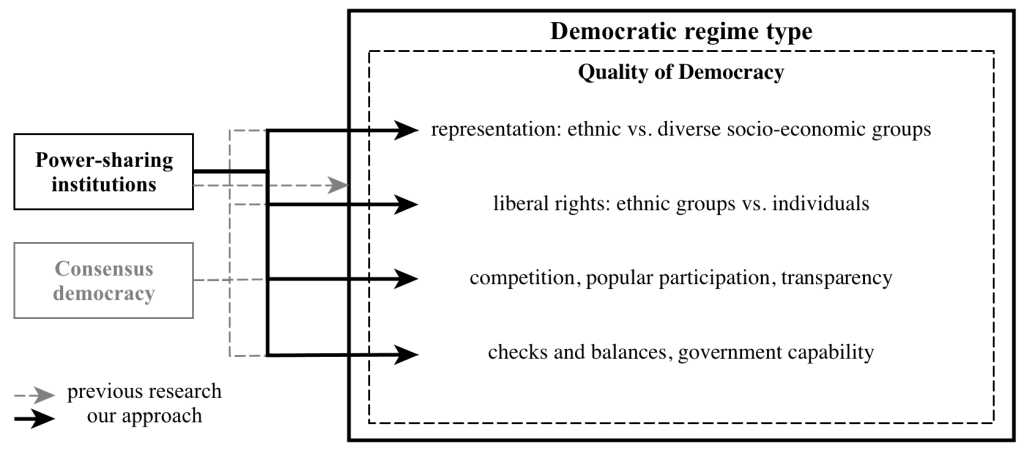
Starting with representation, we find that power-sharing is associated with stronger descriptive representation of ethnic minorities in both government and parliament (a pattern one would expect given that inclusive institutions are explicitly designed for this purpose). What we did not expect was that power-sharing also correlates positively with women's representation. The conventional wisdom held that ethnically structured institutions would crowd out gender as a political category and marginalize women within ethno-political hierarchies. Our data do not support this prediction. Nor do we find evidence that power-sharing disadvantages other socio-economic groups. Ethnic minorities' representational gains under power-sharing are therefore not achieved at the expense of class-based or socioeconomic inclusion.
The picture for liberal rights is similarly more favorable than case-based accounts suggest. Power-sharing countries score higher on formal liberal rights (including freedom of religion, association, speech, and the press), even rights that have no obvious direct connection to the ethnic accommodation logic of power-sharing. The theoretically predicted infringements on individual rights, such as restrictions on self-identification that might be necessary to maintain group boundaries, are not detectable in our data at the cross-national level. This does not mean individual-rights tensions are absent in specific cases, but as a systematic pattern they are weaker than critics have claimed.
The democratic dimensions of participation and vertical accountability offer a more mixed verdict. We do find that power-sharing is associated with lower levels of informal public participation (fewer demonstrations, fewer strikes), consistent with the elite-cartel critique that consociational bargains tend to produce a passive public. Yet this demobilization effect does not generalize to other outcomes: we find no evidence of reduced engagement in civil society organizations, which runs against the stronger claim that power-sharing broadly suppresses associational life. Transparency is similarly ambiguous. Expected negative patterns in power-sharing regimes (such as limits on party finance disclosure, lower bureaucratic autonomy, and elevated perceptions of corruption) are present in the data but mostly fall short of conventional significance thresholds, and there is considerable heterogeneity between cases.
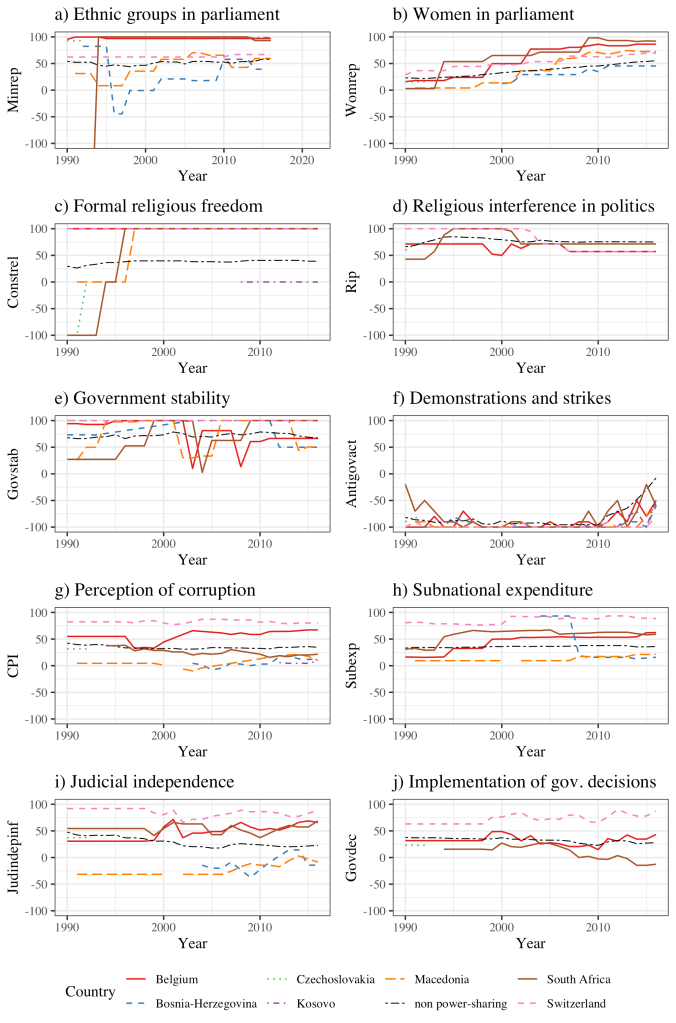
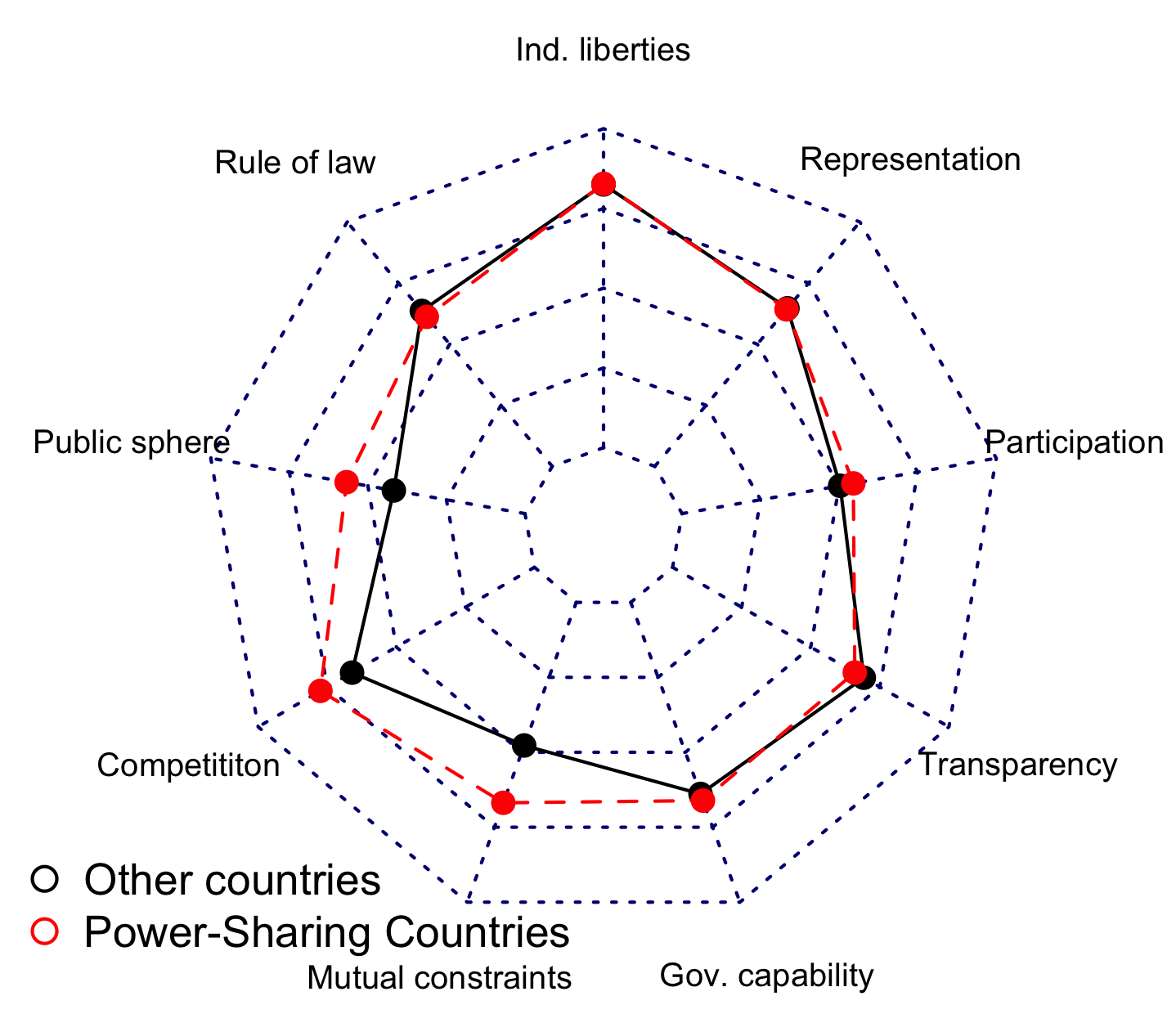
That heterogeneity of democratic outcomes under power-sharing is visualized in figure 2, which displays democratic trajectories in countries like Switzerland and Belgium alongside Bosnia and Herzegovina, Kosovo, Macedonia, and Lebanon. The variation is substantial. For instance, Switzerland and Belgium combine power-sharing with high scores on transparency and participation; Bosnia, Kosovo, and Lebanon do not. This is a reminder that power-sharing institutions do not operate in isolation from historical legacies, state capacity, and the depth of underlying divisions.
On checks, balances, and government capability, we find a polarized pattern. Power-sharing is positively associated with partisan horizontal checks (federalism, bicameralism, fiscal decentralization), which fits the theory that multiple groups seek institutional guarantees against majority domination. But external checks beyond elite control tell a different story: judicial independence is lower and central bank independence weaker under power-sharing. The cartelization of elite power thus appears to extend to constraining institutions that might otherwise check it from outside. Interestingly, however, this does not appear to translate into reduced government capability. Public confidence in government is if anything higher in power-sharing systems, and we find no evidence that the mutual-veto architecture produces the policy paralysis critics predict.
Taken together, these results offer a nuanced reappraisal of power-sharing's democratic record. Its advantages (more inclusive representation, stronger formal liberal rights, and robust partisan checks) are largely confined to the domains most directly shaped by its institutional logic, rather than producing broad democratic spillovers. The "kinder and gentler" characterization is thus supported, but only partially. A more disaggregated, complementary analysis adds further refinement: corporate power-sharing specifically drives ethnic minority representation gains, while liberal power-sharing is more strongly associated with women's representation. This distinction matters for how one evaluates different power-sharing designs. These trade-offs are pursued further in my upcoming book, which reanalyzes them with updated, more extensive data covering more power-sharing cases and a temporally more extensive sample.
For policymakers and scholars working on deeply divided societies, these findings counsel against both the wholesale endorsement and categorical rejection of power-sharing. According to our cross-national analysis, power-sharing's institutional architecture delivers on democratic aspects that it is most directly designed to deliver, without the far-ranging democratic side-effects often predicted, but also without the transformative democratic upgrading that enthusiasts sometimes promise.
For detailed findings and methodology, please check out the article linked in the header above.