Democracy promotion through power-sharing: The role of mediators' constitutional templates
Analysis of how mediator countries' own institutional experiences influence their institutional recommendations in multiethnic countries.
When international mediators help design institutions in divided societies, they are often portrayed as neutral brokers armed with a universal set of constitutional solutions. This chapter challenges that assumption. It argues that mediators carry their own institutional experiences into the negotiation room: the power-sharing arrangements embedded in their home constitutions shape the kinds of models they promote abroad. Far from being incidental, these domestic templates leave a visible imprint on post-conflict settlements, influencing which institutions fragile states ultimately adopt.
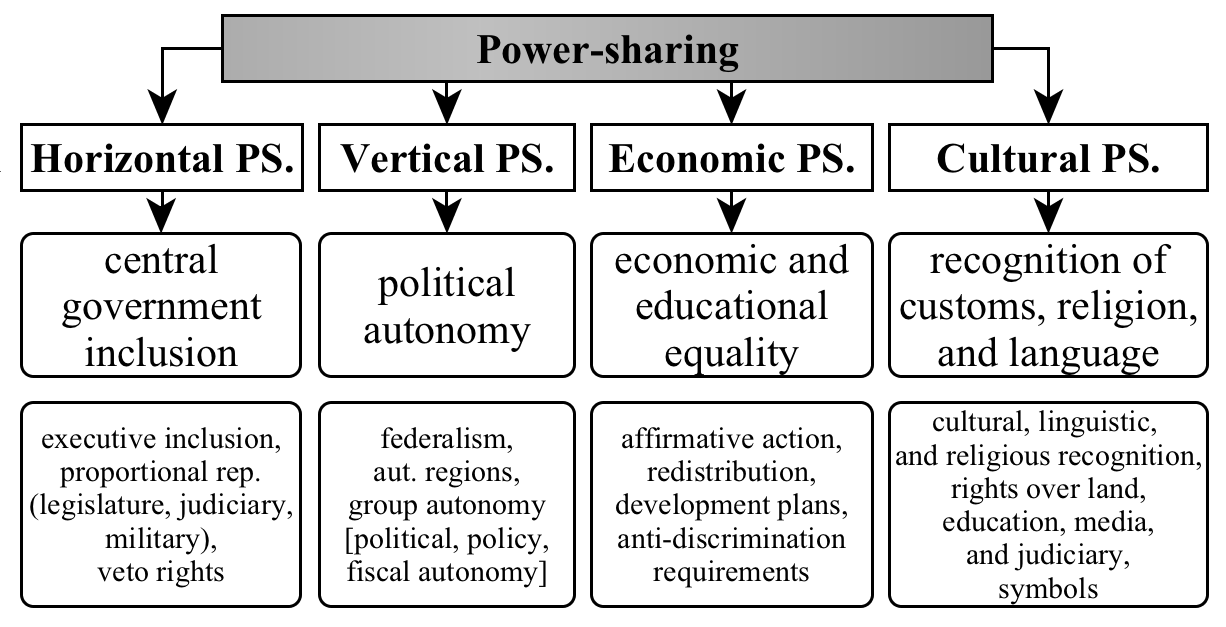
Power-sharing has become one of the most widely prescribed remedies for managing ethnic diversity and preventing the return of civil conflict. Yet power-sharing is not a single institutional recipe. It comes in two broad and consequentially different forms. Corporate power-sharing encodes group identities directly into the constitutional text (fixed ethnic quotas in parliament and government, formal veto rights reserved for named communities) as in Bosnia, Lebanon, Belgium, Cyprus, and Kosovo. Liberal power-sharing, by contrast, uses more flexible, electorally-grounded mechanisms (proportional representation, supermajority thresholds, rotating presidencies) that do not pre-assign seats or veto rights to specific groups, as seen in post-apartheid South Africa, post-2003 Iraq, North Macedonia, and Fiji. The choice between these two models is far from trivial: corporate arrangements offer stronger guarantees of minority inclusion but risk entrenching and hardening group divisions, while liberal arrangements preserve more institutional flexibility but may offer weaker protections for vulnerable communities.
Prior scholarship has devoted considerable attention to whether international mediation leads to peace agreements and whether power-sharing provisions appear in those agreements. Far less attention has been paid to a prior question: when mediators advocate power-sharing, which type do they advocate, and what drives that choice? Neither the preferences of host-state actors nor debates about which design is more effective produce a clear prediction. We argue that a neglected factor fills this explanatory gap: mediators' own institutional experience at home.
Our main argument in this chapter is that mediators act as inadvertent (and sometimes deliberate) exporters of their own constitutional templates. Three reinforcing mechanisms explain why:
- Instrumentally, mediators have seen their home country's model operate in practice and tend to regard it as viable.
- Normatively, they are socialized into thinking of their own system as an appropriate framework for managing diversity.
- And pragmatically, the institutional toolkits they know best are the ones most readily available when drafting constitutional provisions under time pressure. In host states with a mediating country whose own constitution features corporate power-sharing, we expect its mediators to promote corporate arrangements; where it features liberal power-sharing, we expect them to promote liberal ones.
We test this argument with systematic data on 130 countries from 1946 to 2011. Power-sharing levels are measured using country-year indices from the Constitutional Power-Sharing Dataset, which separately tracks corporate and liberal provisions. Mediation events are drawn from the Civil Wars Mediation dataset and the Managing Intrastate Low-Intensity Conflict dataset, excluding very short interventions of less than ten days. Our explanatory variable (mediator templates) is constructed by averaging each mediating country's own maximum corporate or liberal power-sharing score across all mediators active in a host state over the preceding twenty years. We estimate two-way fixed effects models with country and year fixed effects, identifying the effect from within-country changes in power-sharing levels over time.
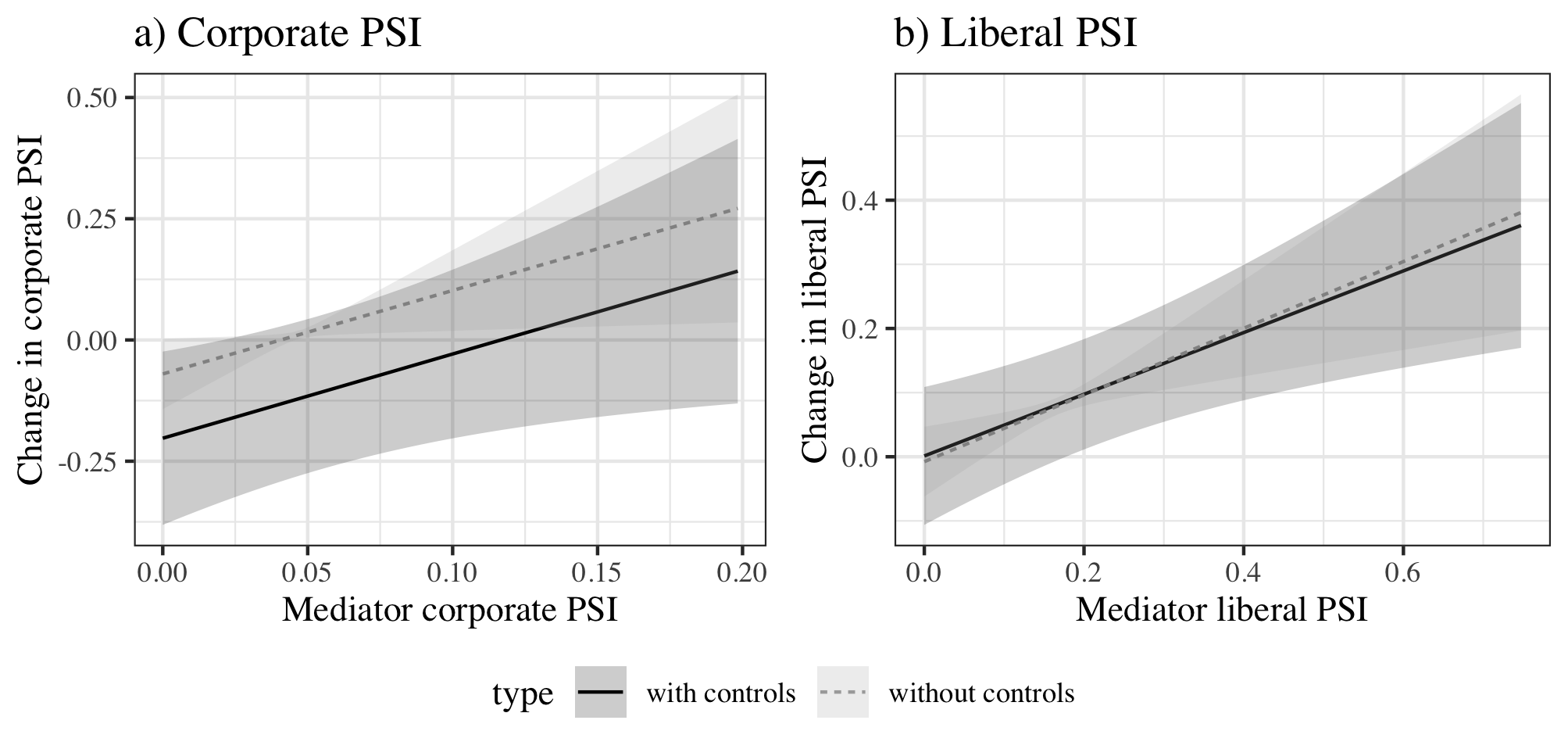
We find a strong role for mediating countries' constitutional templates in influencing the constitutional design divided countries eventually adopt. Mediation in isolation (without accounting for who the mediators are) has no consistent effect on which type of power-sharing a state adopts. But once we distinguish mediators by their home-country institutional experience, the picture sharpens considerably. Host states that receive mediation from countries with corporate power-sharing experience (reaching the maximum observed value of 0.2 on the corporate index) are predicted to increase their own corporate power-sharing score by between 0.14 and 0.27 points. Similarly, host states exposed to mediators with extensive liberal power-sharing experience (reaching the maximum observed value of 0.74 on the liberal index) are predicted to increase their own liberal power-sharing score by 0.36 to 0.38 points. These are substantively meaningful shifts in constitutional design.
Additional qualitative case illustrations help flesh out the statistical patterns. In Burundi, South African mediators shaped the 2004 constitution's power-sharing provisions in ways that closely echoed South Africa's own 1993--1995 interim constitutional arrangements, a liberal model. In the post-Yugoslav successor states of Bosnia, Kosovo, and Macedonia, EU and NATO member states whose own constitutions feature corporate ethnic arrangements were centrally involved in negotiating the corporate power-sharing frameworks that emerged. In Iraq following 2003, the US-led transitional administration pushed a liberal framework consistent with American constitutional traditions. In Comoros in 2000, South African mediators again successfully exported a power-sharing model influenced from their own democratic transition.
In sum, international mediators are often presented (and present themselves) as impartial facilitators helping conflict parties reach agreements that reflect local needs and democratic best practices. Our findings complicate that picture. Mediators arrive carrying constitutional histories that quietly inform what they regard as appropriate, feasible, and familiar. The type of power-sharing that ends up in a host state's constitution may therefore owe as much to which countries happened to mediate the conflict as to the interests of domestic actors or the most suitable design for that particular society. Recognizing this dynamic does not mean mediation is illegitimate or unhelpful, but it does suggest that both host-state actors and scholars of democracy promotion should scrutinize the institutional templates that external actors bring to the table.
For detailed findings and methodology, please see the chapter linked in the header above.