Terminating the war, losing the peace? Constitutional power-sharing and its discontents
Theory and cross-national analysis on the impact of constitutional power-sharing on peace, democracy, and the legitimacy of the political system.
Terminating the war, losing the peace? Constitutional power-sharing and its discontents
Can constitutional power-sharing end ethnic civil wars without limiting democratic quality and sowing the seeds of future instability? The international community has long promoted inclusive arrangements where power is to be shared between former rivals as the standard prescription for divided societies. However, in many cases, such arrangements lack the broad-based domestic legitimacy needed to make peace last. Addressing this challenge, this book provides one of the most comprehensive cross-national evaluations to date of when, and for whom, constitutional power-sharing delivers on its twin promises of peace and democracy.
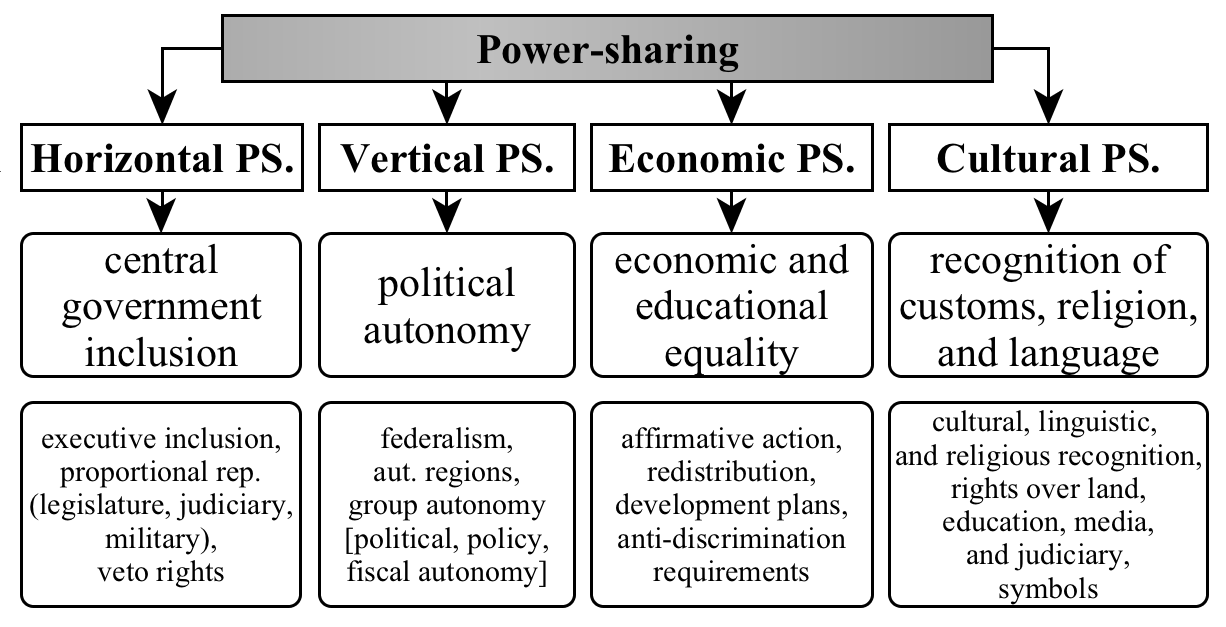
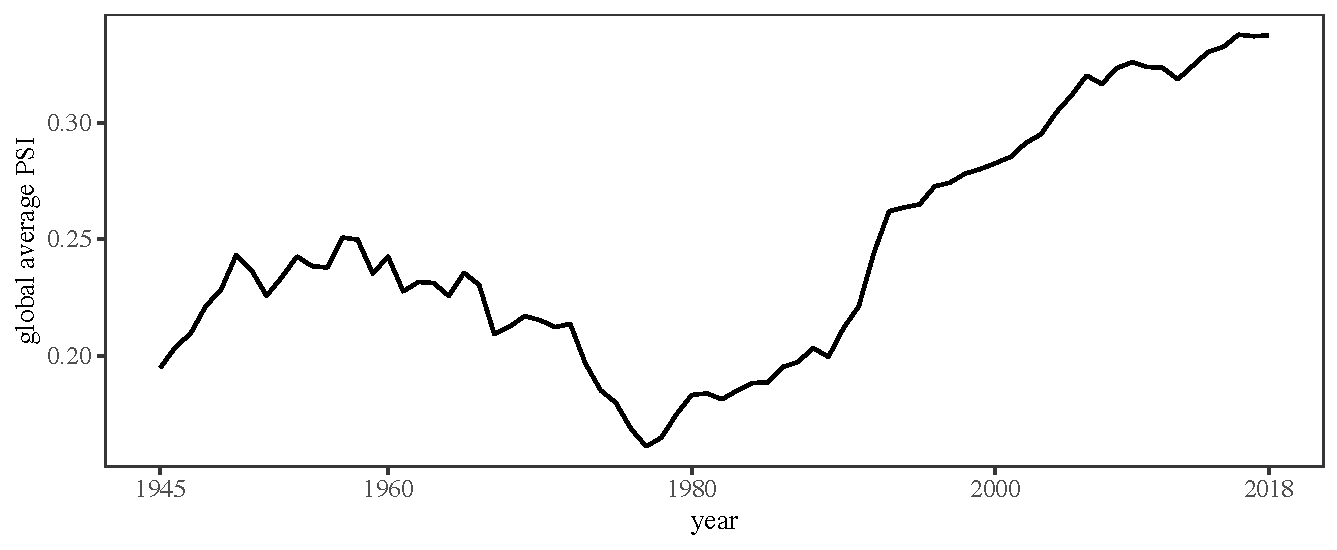
From Bosnia and Herzegovina to Nepal, South Africa, and Iraq, constitutional power-sharing has been at the center of internationally mediated peace settlements in multi-ethnic states. Such arrangements, which require diverse ethnic groups to share executive authority, legislative representation, and veto rights over key decisions, have spread steadily since the end of World War II, promoted by mediators, the United Nations, and conflict scholars alike (see figure 1). Yet their track record appears mixed. Bosnia's constitution ended a bloody civil war but generated pervasive discontent, with major Bosniak nationalist parties opposing its restrictions on majority rule, continued Serb separatist threats, Croat dissatisfaction over the lack of a separate ethno-region, and with Jewish and Roma citizens excluded from political life altogether. Nepal's 2007 power-sharing constitution similarly ended a decade-long insurgency but was followed, the very next day, by increasingly violent protests from the Madhesi minority who felt dissatisfied with the new constitution's inclusive protections. Kosovo's power-sharing provisions secured international support but has faced persistent domestic opposition. These cases inspire the book's central question: does constitutional power-sharing terminate ethnic civil wars at the cost of losing the peace?
To address this question, I formulate a social psychological framework, which recenters the analysis on ordinary citizens rather than political elites. Classic theories of power-sharing, along with most subsequent quantitative research, treat the public as a passive bystander, focusing instead on elite bargains and macro-level outcomes like civil war onset. I argue that such a focus is fundamentally incomplete. When elites conclude a power-sharing deal, the constitutional settlement still has to be accepted (and lived with) by the ordinary citizens it governs. Their attitudes-including grievances over their group's treatment and the salience of their ethic identity in their political and social attitudes-are not merely a downstream consequence of institutional design; instead, they are a critical mediating mechanism that determines whether peace and democracy can endure (see figure 2).
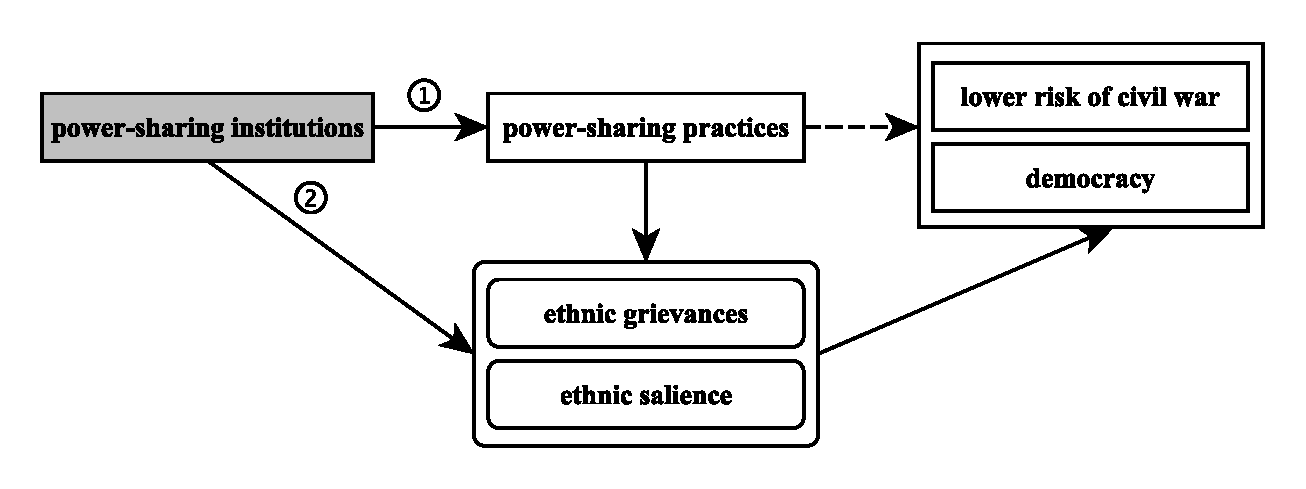
I argue that two dimensions of legitimacy matter in particular: vertical legitimacy (citizens' loyalty to the political system) and horizontal legitimacy (positive attitudes between ethnic groups). If constitutional power-sharing fails to generate these attitudes, its aggregate benefits for peace and democracy can be gradually undermined from below: by newly excluded minorities who feel left behind, by majority communities who resent restrictions on their political dominance, and by enduringly polarized ethnic divisions that continue to be politicized rather than gradually transcended.
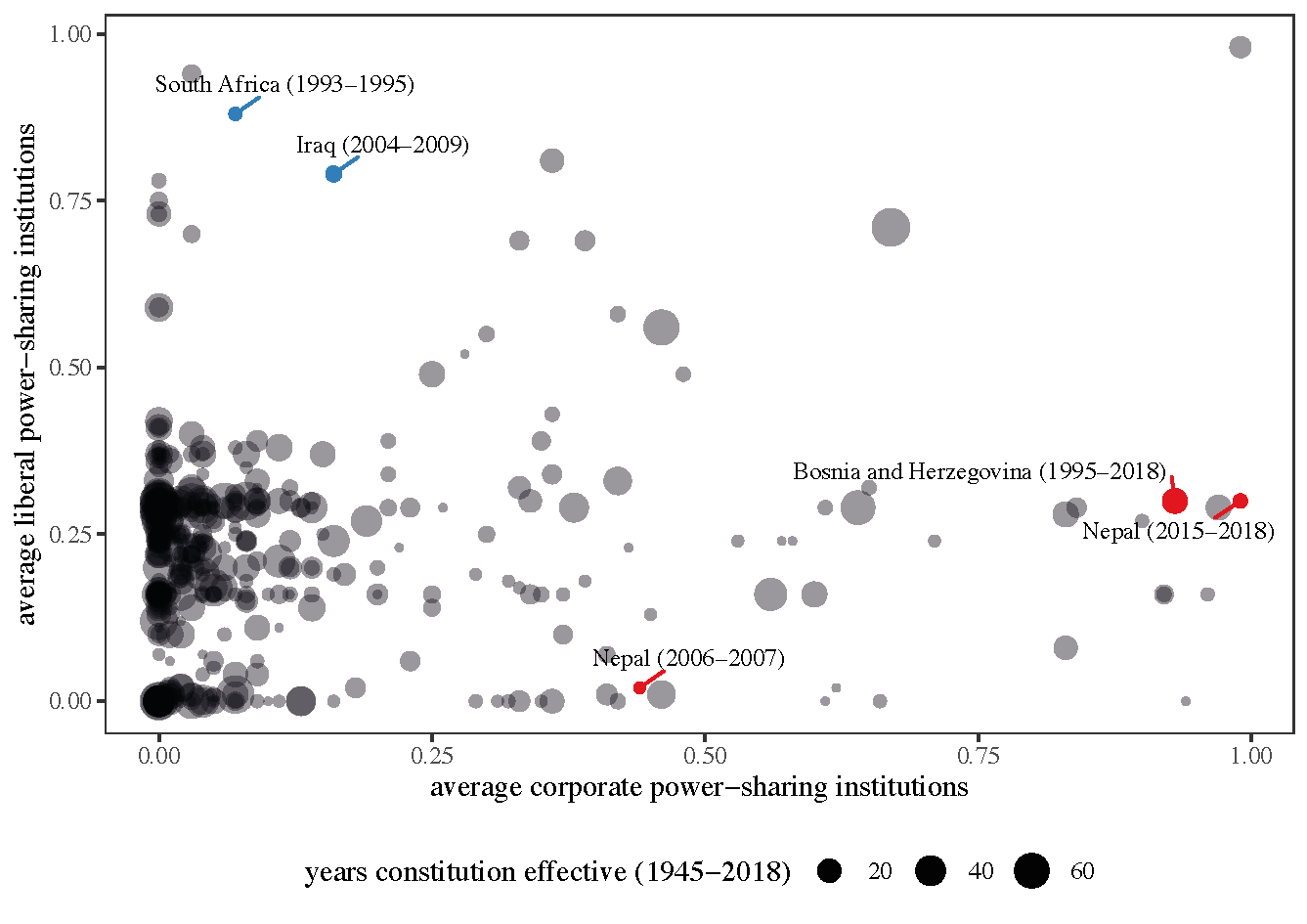
Focusing on the specific institutional templates available to policymakers, this book draws a central institutional distinction between corporate and liberal types of power-sharing. Corporate power-sharing, as implemented in Bosnia, Burundi, Lebanon, and Nepal, divides authority according to rigid, ethnically-based formulae, relying on ethnic government quotas, proportional legislative representation, and mutual veto rights over key decisions. Liberal power-sharing, as practiced in post-apartheid South Africa, Fiji, and post-Hussein Iraq, avoids predetermined ethnic categories and instead encourages inclusion indirectly through electoral incentives such as low entry thresholds for government participation, proportional electoral systems, and supermajority requirements. These institutional differences are not merely technical but have fundamentally different implications for who benefits from power-sharing, who is antagonized by it, and how divided societies evolve over time.
To assess the consequences of corporate and liberal power-sharing, this book conducts a range of large-N, globally representative quantitative analyses. These analyses draw on two major datasets assembled specifically for this project, allowing it to systematically integrate evidence from a globally representative set of power-sharing cases and contrast them with alternative institutional arrangements:
-
The first is the Constitutional Power-Sharing Dataset (CPSD) 2.0, covering 181 countries from 1945 to 2018. This is the most comprehensive cross-national database of constitutionally entrenched power-sharing available, distinguishing systematically between its corporate and liberal subtypes (see figure 3) and tracking how each arrangement shapes the political status of individual ethnic groups over time.
-
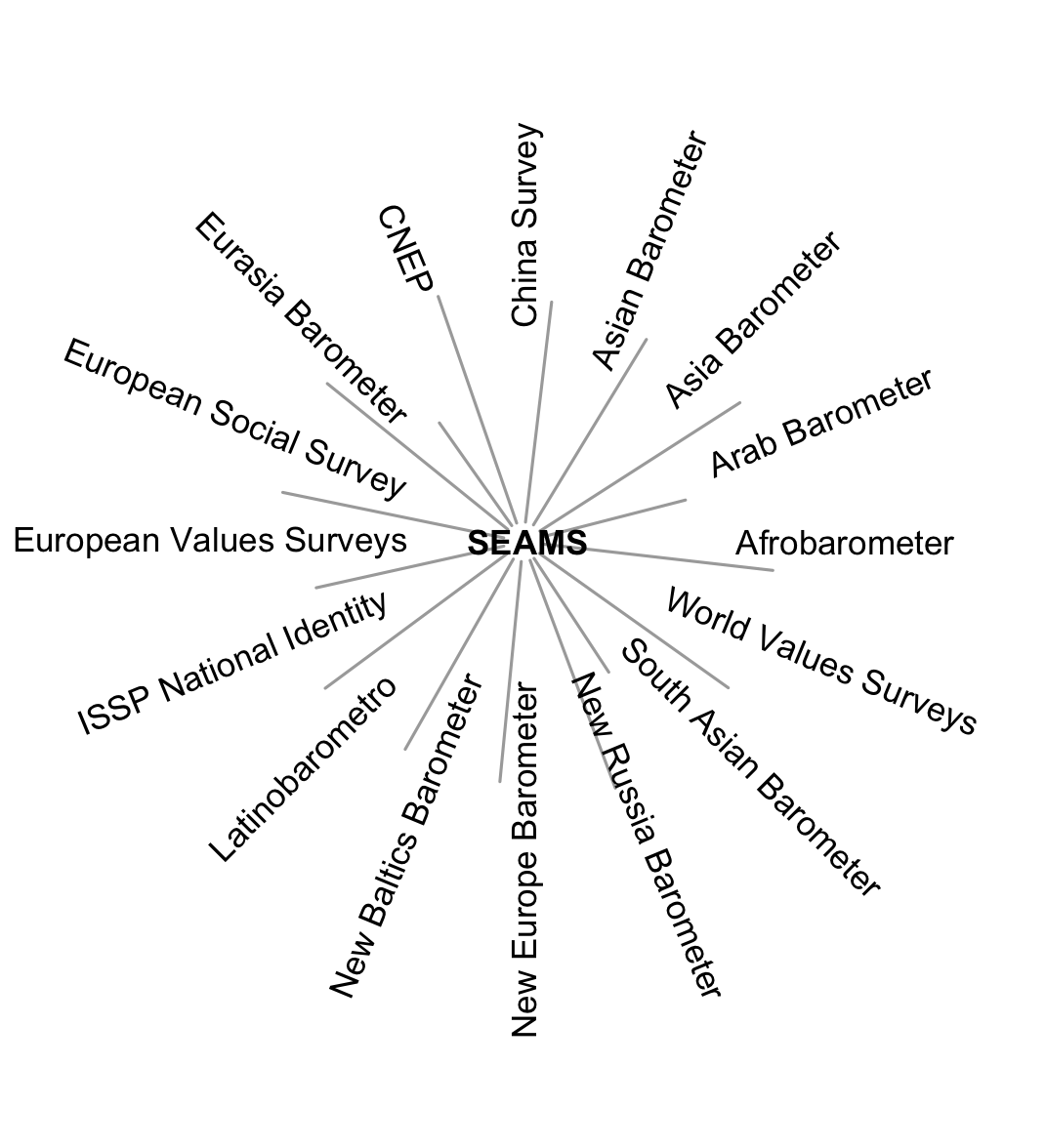
The second is the Standardized Ethnically Attributed Mass Surveys (SEAMS) database, which harmonizes global survey sources, including the World Values Survey and world regional barometer surveys, to produce comparable data on political and social attitudes for over two million respondents across 148 countries.
Using these data, my statistical analyses proceed in two parts. At the macro-level, a quantitative analysis covering 39,127 ethnic-group-years between 1946 and 2017 examines the impact of constitutional power-sharing on the risk of ethnic civil war, while a country-level analysis across 181 states since World War II investigates its effects on democratic quality (liberal rights, citizen participation, deliberation, and egalitarianism). At the micro-level, hierarchical multi-level models using the SEAMS survey data examine how constitutional power-sharing affects minority grievances among newly included groups (government satisfaction, discrimination perceptions) and among constitutionally disadvantaged groups left outside its protective umbrella (like the Jewish and Romani minorities in Bosnia). Further analyses investigate how the formerly dominant "majority" community responds to power-sharing, examining grievances, threat perceptions, protest participation, and inter-ethnic violence. A final empirical chapter turns to the long-run question of ethnic salience (whether citizens privilege ethnic over national identity and intend to vote for ethnically based parties), while four qualitative case studies (Bosnia, Nepal, South Africa, Iraq) trace the causal mechanisms at work in contrasting institutional contexts.
My findings illuminate three difficult trade-offs that policymakers in multi-ethnic states must confront:
-
A first trade-off runs between the depth and scope of power-sharing. Corporate arrangements offer the most enforceable inclusive guarantees for constitutionally recognized minorities, strongly reducing their grievances and the short-term risk of civil war. Yet the very act of privileging some groups necessarily disadvantages others. Relatively marginalized minorities (Roma and Jewish citizens in Bosnia, Madhesi and Tarai groups in Nepal) are more likely to face political exclusion, perceive discrimination, and engage in anti-government protests. Liberal power-sharing avoids such discriminatory choices by offering weaker but more universally accessible guarantees, making it more compatible with democratic consolidation in the long run.
-
A second trade-off is between minority rights and majority rule. Corporate power-sharing visibly circumscribes the political dominance of formerly powerful groups, making it more prone to generating majoritarian backlashes, spurred by grievances and threat perceptions, and culminating in anti-government mobilization among core community members. As the cases of Cyprus, Rwanda, and Nepal illustrate, such backlashes can derail democratization processes and, in some cases, spark renewed large-scale violence. In contrast, liberal power-sharing, relying on formally group-blind provisions, provokes fewer such reactions and is better placed to maintain societal cohesion.
-
A third trade-off is between the imperatives of short-term conflict prevention and long-term depolarization. While corporate power-sharing most effectively reduces violence in the immediate aftermath of conflict, its enduring ethnic categorization of citizens keeps ethnic identities salient over time, rendering individuals more likely to identify primarily as ethnic group members and to vote for ethnically based parties. Prolonged exposure to informal or liberal power-sharing, by contrast, is associated with declining ethnic salience, as inter-group inequalities gradually recede and ethnic identities lose some of their practical utility as guides to political life.
As my findings are based on constitutional data, they point to concrete implications for constitutional design. Where instability is acute and insurgent groups demand enforceable guarantees, corporate power-sharing may be unavoidable, and my cross-national evidence confirms its substantial pacifying effects in such contexts. But policymakers who adopt corporate arrangements should plan from the outset for addressing corporate power-sharing's drawbacks. Mitigating measures may involve extending quotas to all minority groups rather than a narrow, constitutionally privileged set; complementing minority guarantees with explicit affirmations of the majority community's continued role; and building in medium-term pathways toward more flexible, electorally based arrangements as inter-ethnic trust develops.
In sum, this book's systematic, global evidence is considerably more positive than assessments based on individual, prominent post-conflict cases like Bosnia or Lebanon suggest. Both types reduce civil war risk, and liberal power-sharing consistently promotes democratic progress. But institutional form matters enormously for who benefits, who dissents, and whether the resulting peace is likely to endure: to terminate civil wars and win the ensuing peace, constitutional engineers must navigate difficult trade-offs between depth and scope, minority rights and majority rule, and short-term stabilization and long-term depolarization.