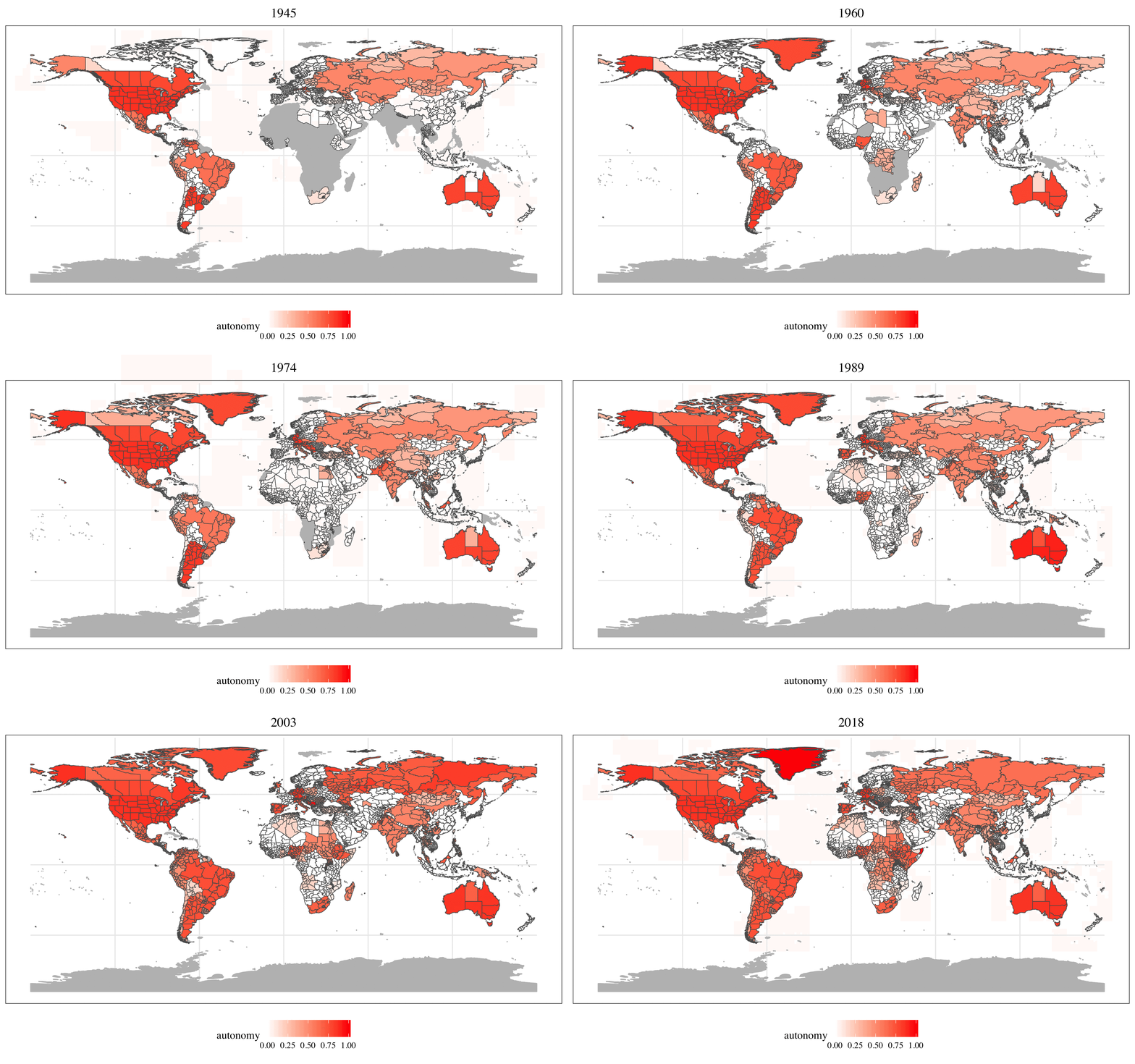
Managing self-determination struggles through decentralization
A review of the literature on regional autonomy and federalism as tools for managing self-determination conflicts.
Managing self-determination struggles through decentralization
** Can granting minorities regional self-rule prevent them from pursuing full independence, or does it instead equip them with the institutional tools needed to eventually break away? Few questions in the study of ethnic conflict and territorial politics have generated as much sustained disagreement as this one. Decentralization (through federalism, regional autonomy, or devolution) is among the most widely recommended policy responses to secessionist conflict. Yet after decades of comparative research, the empirical verdict remains strikingly inconclusive: decentralization appears to both reduce and increase the risk of secession, depending on the context.**
In this chapter, written with Kristin Bakke for the Routledge Handbook on Self-Determination and Secession, we take stock of this extensive literature. Our goal is not only to summarize what is known, but to explain why the debate has proven so resistant to resolution, and to outline three analytical directions that we argue are essential for moving the field forward.
The Core Policy Paradox
The case for decentralization as a conflict-management tool rests on several well-established mechanisms. By transferring authority over local governance to minority-populated regions, autonomy arrangements can directly address political grievances that often underpin secessionist mobilization. They may also signal recognition and respect from the central state, thereby strengthening trust and reducing perceived marginalization. In addition, by incorporating minority elites into regional governing institutions, decentralization can create strong incentives for these actors to pursue influence within the state rather than outside it.
At the same time, an equally robust set of arguments identifies potential risks. Decentralization can unintentionally strengthen secessionist movements by providing them with administrative capacity, fiscal resources, and institutional experience that make independence more feasible. Rather than weakening territorial identities, it may consolidate them by formalizing regional boundaries and empowering political entrepreneurs whose careers depend on mobilizing identity-based constituencies. In some cases, devolved institutions may even be captured by more radical actors, who use regional autonomy not as a mechanism of accommodation, but as a platform for escalation and increased demands for sovereignty.
The result is a persistent disagreement on the overall effect of autonomy on secessionism. As outlined above, the same institutional features of autonomy appear capable of both stabilizing and destabilizing states.
Why the Literature Remains Inconclusive
One of the central claims of our chapter is that this ambiguity is not simply the product of insufficient data or measurement error. Rather, it reflects a deeper theoretical issue: the effects of decentralization are highly conditional on context. Treating decentralization as a uniform "treatment" applied across comparable contexts obscures the fact that it interacts systematically with political history, social structure, and institutional design.
Aggregated cross-national findings often produce contradictory conclusions not because the evidence or method of analysis is flawed, but because the underlying processes are heterogeneous. Moving beyond this impasse requires more explicit attention to the conditions under which decentralization is likely to produce accommodation versus escalation.
We therefore identify three research areas that, taken together, can move this research forward: the origins of decentralization, the societal context into which it is introduced, and the design of autonomy arrangements themselves.
1. The Origins of Decentralization
A first and still often underappreciated challenge concerns selection bias. Autonomy arrangements are rarely implemented under neutral conditions. Instead, they are most frequently adopted in response to significant political pressure, often in contexts where secessionist conflict is already intense or escalating.
This creates a fundamental problem of comparison. Regions that receive autonomy are not comparable to those that do not adopt similar reforms; they are typically cases in which the underlying risk of conflict is already high. Naïve empirical comparisons may therefore systematically underestimate the pacifying effects of decentralization, since it is often introduced in the most difficult and conflict-prone environments.
Recent advances in the field have begun to address this issue through more sophisticated research designs, including natural experiments, instrumental variable approaches, and in-depth process tracing. We argue that continued progress in causal identification is essential if the field is to move beyond descriptive disagreement toward more credible inference about policy effects.
2. The Importance of Societal Context
A second insight is that decentralization does not operate in isolation from the social environment in which it is embedded. For instance, its effects depend heavily on the characteristics of the relevant population groups, their historical relationships, and the broader political setting.
Mounting evidence suggests that autonomy is more likely to have stabilizing effects under certain conditions: when regions are internally diverse rather than highly homogeneous; when there is limited prior exposure to violent inter-ethnic conflict; when minority groups maintain meaningful political and institutional linkages to the central state; and when decentralization is introduced preemptively rather than as a response to sustained conflict.
These contextual factors shape both elite incentives and mass expectations. In some settings, decentralization promotes cooperation and shared commitment to the state. In others, it can reinforce divisions, sharpen ethno-regional identities, and intensify secessionism.
3. Institutional Design Matters
A third dimension concerns the institutional design of autonomy arrangements themselves. Decentralization is not a single institutional package but a broad family of reforms that vary significantly in structure and scope.
Important design features include the number and size of subnational units, the degree to which administrative boundaries align with ethnic settlement patterns, the range of competencies devolved to regional governments, and the mechanisms established for coordination between central and regional authorities. These choices shape the incentives faced by political elites and determine whether decentralization encourages bargaining within the state or competition over the boundaries of the state.
Equally important, institutional design influences how decentralization is perceived by affected populations. Autonomy may be experienced as meaningful inclusion in some configurations, but as symbolic concession or purposeful containment in others. These perceptions, in turn, feed back into political behavior and long-term stability.
Moving the Debate Forward
Our central argument is that the longstanding stalemate in the decentralization literature reflects a need for more systematic theory about and analysis of conditional effects. Progress depends on disaggregating the analysis along three dimensions: the origins of autonomy arrangements, the contextual environments in which they are introduced, and their institutional design.
Taken together, these dimensions offer a framework for systematically studying when decentralization reduces secessionist conflict and when it may inadvertently intensify it. These themes run through the empirical contributions that accompany this handbook chapter.
For detailed findings and methodology, please see the full chapter linked above.