Ethnic accommodation and the backlash from dominant groups
Cross-national quantitative analysis of when different types of ethnic accommodation (including power-sharing, autonomy, and multiculturalism) engender a majoritarian backlash from the dominant ethnic group.
Ethnic accommodation and the backlash from dominant groups
Why does granting power-sharing, regional autonomy, or cultural rights to ethnic minorities sometimes provoke vehement resistance, in the form of mass protests and communal violence from dominant communities? In my new article in the Journal of Conflict Resolution, I find that such backlashes are systematic, but concentrated: they are driven overwhelmingly by formal, constitutionally-enshrined concessions that explicitly recognize minorities' collective identities, while group-blind alternatives largely avoid this risk. In other words, it matters less whether minorities are accommodated, but what form such accommodation takes.
Since the end of the Cold War, power-sharing, regional autonomy, and multicultural recognition have become the international community's go-to toolkit for managing ethnic diversity, particularly in post-conflict societies. From Bosnia and South Africa to Nepal and Iraq, governments have extended constitutional concessions to subordinate groups in pursuit of peace. Yet a growing counter-trend is also visible, driven not least by a resurgence of dominant nationalism and nationalist geopolitics (see related articles below): in countries such as India, North Macedonia, and Sri Lanka, conservative and nationalist constituencies among dominant groups have responded to such accommodation with large-scale protests, and sometimes even with targeted communal violence against minorities deemed unfairly privileged by accommdative measures. Despite these risks, the mobilization of dominant groups has received remarkably little systematic attention in comparative research, which has focused overwhelmingly on minority grievances and subordinate group conflict.
I address this gap by formulating a theoretical argument that seeks to understand the drivers of majority mobilization against the accommodation of minorities. Adopting a social psychological lens, I argue that ethnic accommodation lends itself to the articulation of grievances and fears among members of dominant groups, especially those who are politically conservative or hold authoritarian value orientations. Nationalist parties can exploit this sentiment by framing accommodation as a violation of individual equality or a threat to the dominant group's national project, thereby organizing protests and inciting communal violence while boosting their electoral prospects.
I argue that two conditions make a large-scale backlash especially likely. First, the presence of at least one dominant nationalist party competing for office, which has incentives to mobilize diffuse discontent and threat perceptions into mass mobilization events. And, second, the adoption of specifically group-based concessions that explicitly recognize subordinate groups' collective identities and enshrine them constitutionally, for example through ethnic government quotas, veto rights, designated minority homelands, or formal cultural recognition, which lend themselves particularly well to the articulation of fears and injustice frames. North Macedonia's 2001 Ohrid Agreement, which recognized the Albanian language and prompted decentralization, illustrates the first mechanism: nationalist parties mobilized widespread protests and deadly anti-Albanian riots to sharpen their electoral profiles. India's Hindu nationalist parties, repeatedly exploiting concessions on Kashmir's autonomy and Muslim cultural rights, illustrate the second aspect.
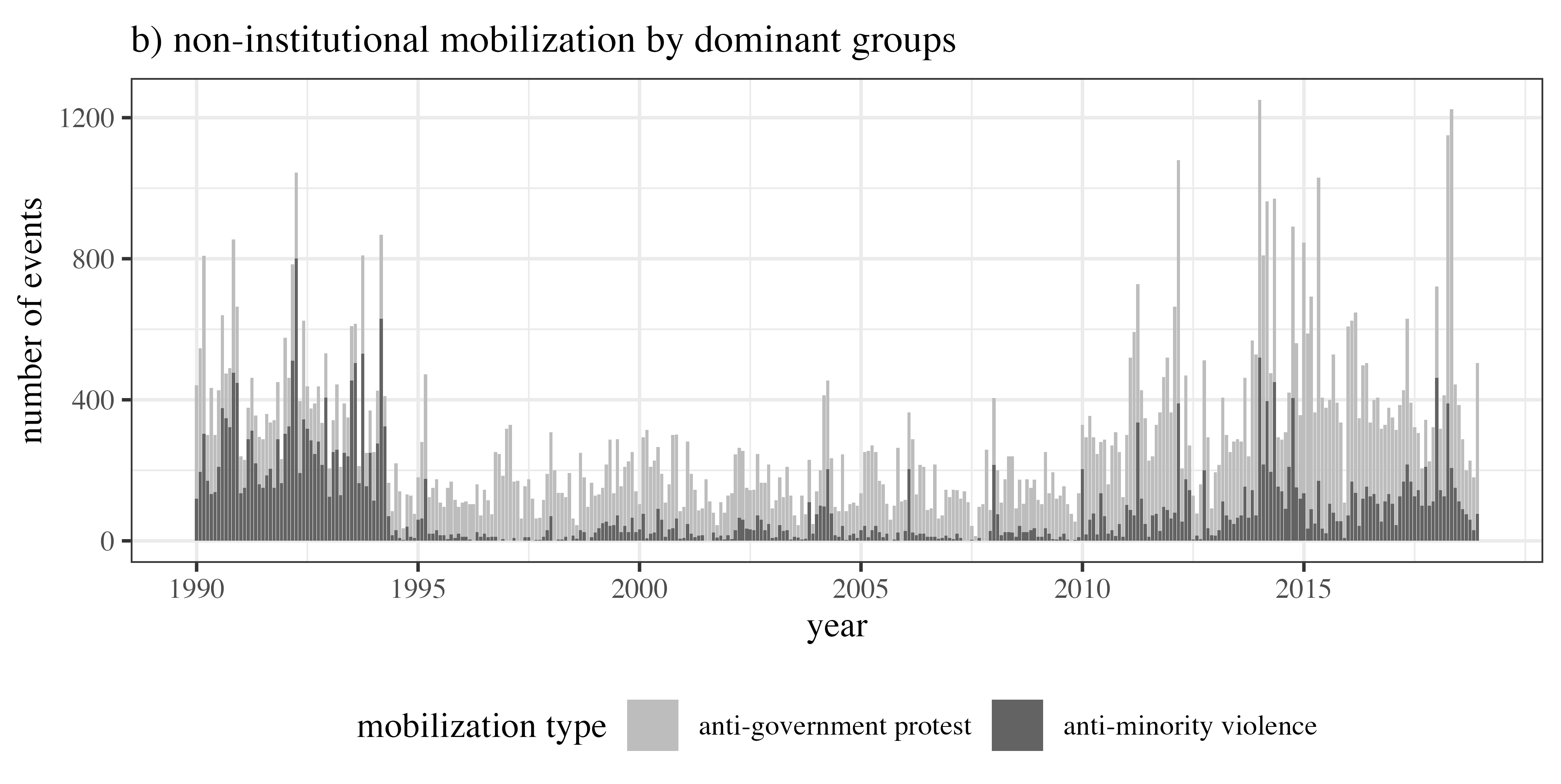
To test these arguments, I compile new monthly data on concessions to ethnic minorities across 125 multi-ethnic electoral regimes between 1990 and 2018, distinguishing group-based from formally group-blind alternatives across both power-sharing and autonomy dimensions. I combine this with ethnically attributed data on anti-government protests and communal violence drawn from the Mass Mobilization Data Project and the Uppsala Conflict Data Program, covering 12,371 mobilization events and 442 concession episodes (figure 1).
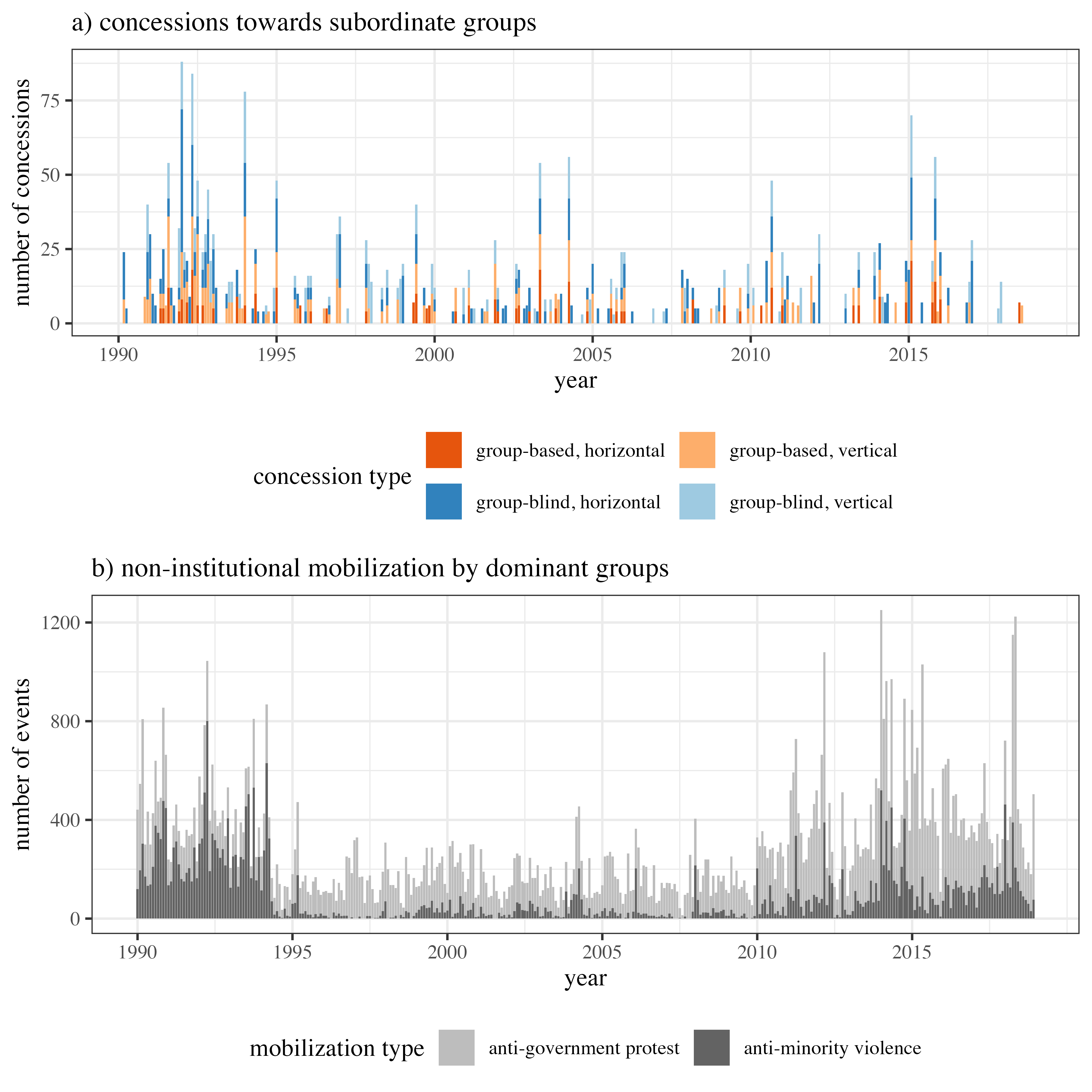
The results are striking (figure 2). I find that dominant group mobilization is substantially more frequent in three-month windows around the introduction of concessions; each additional concession raises predicted monthly events by 0.05 against a baseline mean of 0.32. This effect roughly doubles where a dominant nationalist party competes for office. However, importantly, this backlash is driven almost entirely by group-based concessions: each such concession raises predicted mobilization by 0.09, while the estimated effect of group-blind concessions is statistically indistinguishable from zero. These results are backed up by a series of individual-level analyses, based on survey data covering 176,000 respondents across 73 countries: here, I find that majority group members living under constitutions with group-based concessions show greater willingness to protest, with this effect concentrated among right-wing and authoritarian respondents, which is in line with my proposed argument.
These findings have important policy implications. Most fundamentally, they hold good news for the proponents of accommodation as a conflict resolution strategy. Contrary to fears articulated by prominent advocates and skeptics of accommodation, I find no automatic relationship between accommodation and majority mobilization. Rather, such a relationship is confined to group-based forms of accommodation that explicitly recognize the collective identities of minorities and enshrine them in the constitution. Such measures hence appear more controversial and more prone to generating a majoritarian backlash. Where group-blind alternatives (informal power-sharing pacts, proportional electoral systems, or uniform decentralization) can achieve comparable protective goals for minorities, they hence carry substantially lower risks of a destabilizing backlash from dominant groups.
For detailed findings and methodology, please see the article linked in the header above.