Nationalism, populism, and democracy
New cross-national data and systematic analysis on how dominant nationalism, distinct from populism, drives democratic backsliding by eroding liberal norms, minority inclusion, and electoral institutions.
Nationalism, Populism, and Democracy
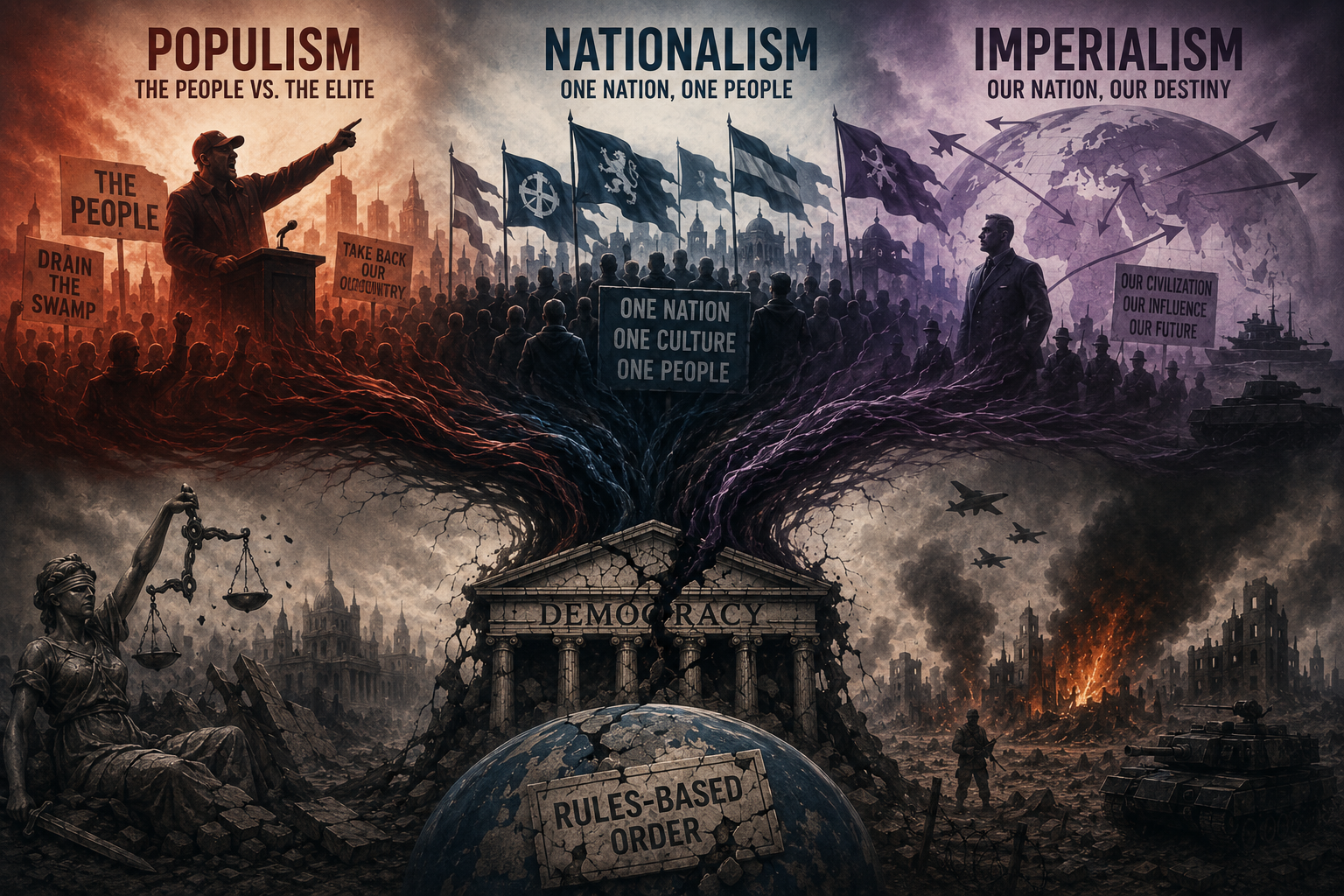
Democratic backsliding has accelerated globally over the past two decades. Influential observers, along with a large and increasing body of research, have attributed much of this trend of declining democracy to populism which has gained political influence across much of the world. In a new working paper, we argue that this diagnosis is incomplete: dominant nationalism, distinct from populism and often overlooked as an independent force, is a more pervasive and consequential threat to democracy.
Dominant nationalism as an independent threat to democracy
We argue that the disproportionate focus on populism in recent scholarship leaves important gaps. First, because populism often occurs together with exclusionary and illiberal forms of nationalism, analysts risk conflating the two, making it difficult to identify which of the two ideologies constitutes the main driver of recent backsliding. Second, in focusing on actors who employ populist rhetoric, it risks missing the independent democratic costs imposed by nationalist leaders who are not simultaneously populist. From Sukarno in Indonesia and Marcos in the Philippines to Erdoğan in Turkey and Modi in India, nationalist leaders have played central roles in democratic decline. Treating these cases exclusively through the lens of populism makes it difficult to assess what actually drives the erosion of democratic institutions.
We develop the concept of dominant nationalism, a politically ascendant form of ethnic nationalism defined by efforts to institutionalize the dominance of a particular ethno-cultural group at the expense of other groups within the same state. We argue that dominant nationalism undermines democracy through four mechanisms:
- First, it clashes with liberal norms and the principle of equal citizenship.
- Second, it deepens ethnic economic inequality by concentrating state resources in the dominant group.
- Third, it erodes the broad-based solidarity that democratic institutions depend on.
- Fourth, dominant nationalists construct threat narratives around national outgroups to justify restrictions on democratic rights and political competition.
Systematically disentangling the democratic effects of nationalism and populism
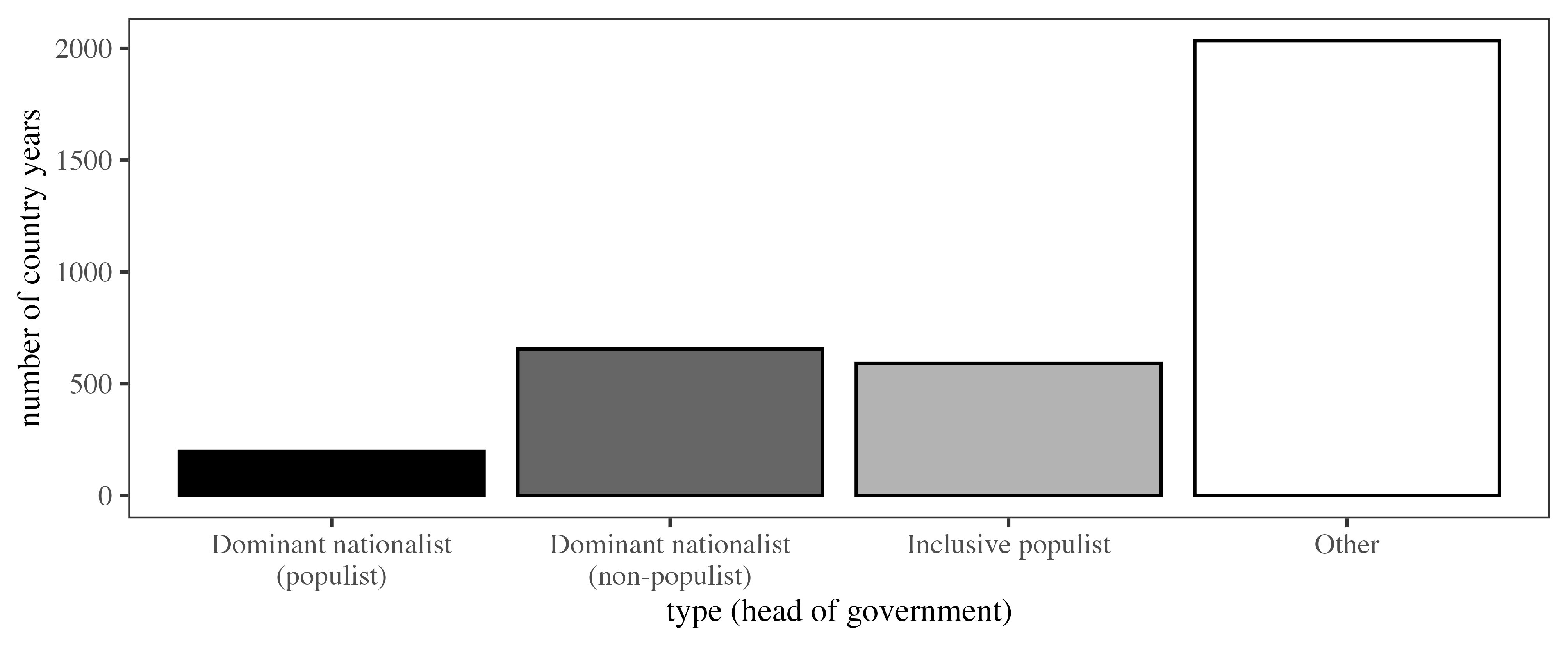
To test these arguments, we draw on new data from the Dominant Nationalist Movements (DNM) Dataset, which codes dominant nationalist heads of government across 90 multiethnic states from 1946 to 2023. We pair this measurement with cross-national populism measures from V-Party and use V-Dem's Liberal Democracy Index as our primary outcome. Our descriptive analysis indicates that, though populism and dominant nationalism frequently overlap, there are large residual categories of dominant nationalists who do not engage in populist rhetoric and of populists who do not hold dominant nationalists' exclusionary convictions (figure 1). Disentangling the two ideologies' democratic impact is therefore necessary.
Our quantitative estimation relies on a Fixed Effects Counterfactual (FECT) estimator designed for staggered treatments, which recovers what democracy levels would have looked like absent nationalist rule.
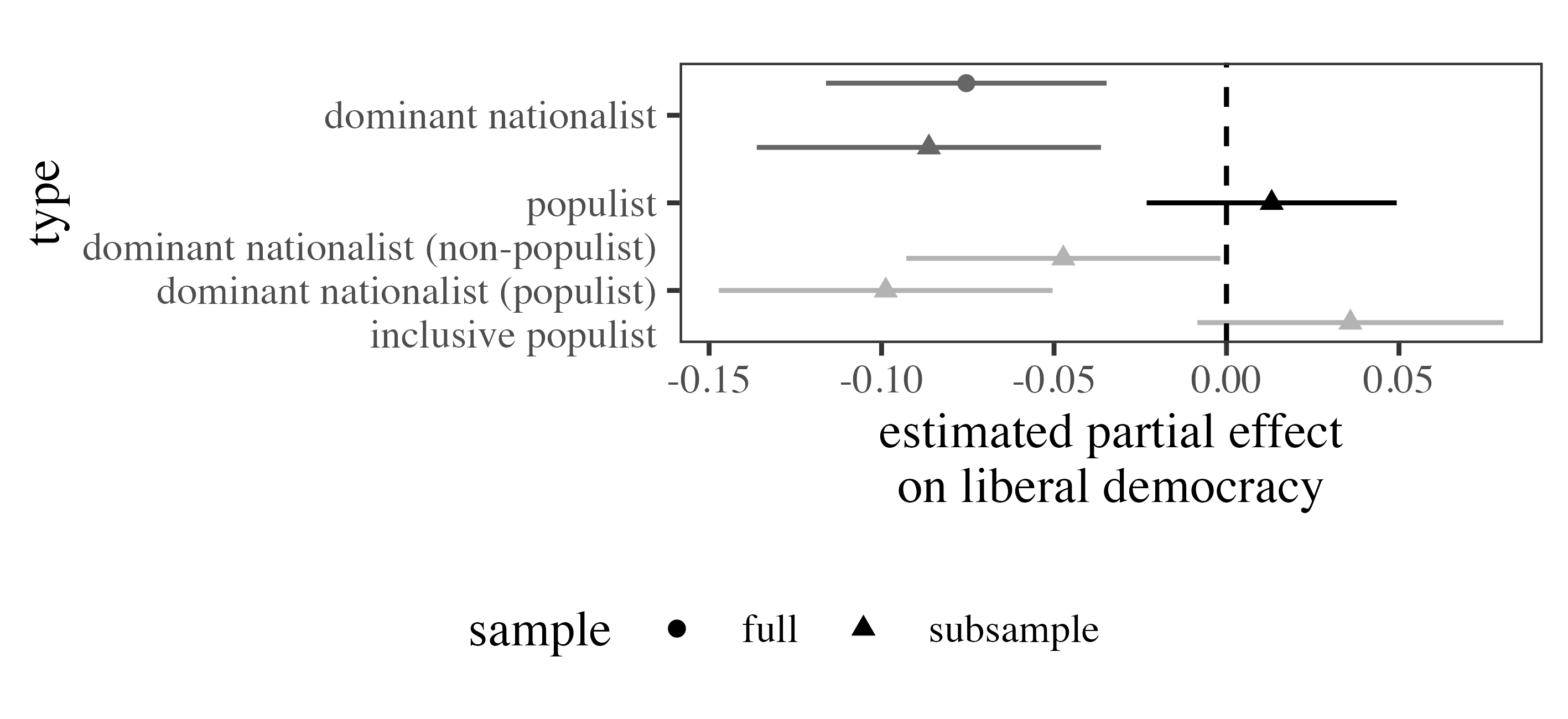
Relying on this model, our results (figure 2) indicate that dominant nationalist heads of government reduce liberal democracy by an average of 0.08 points on a 0–1 scale, with effects intensifying over time and peaking around eight years into nationalist rule. By our estimate, in 2023, multiethnic countries governed by dominant nationalists scored approximately 0.16 points below their counterfactual trajectory. Countries under dominant nationalist rule further face a 3.2 percentage point higher annual risk of autocratization; autocratic dominant nationalist regimes are 1 percentage point less likely to democratize per year.
Crucially, both populist dominant nationalists and non-populist dominant nationalists harm democracy significantly. In contrast, populist leaders without dominant nationalist ties show no consistent negative effect on liberal democracy (if anything, we obtain a slight positive association; figure 2). This pattern indicates that dominant nationalism is likely the main mechanism driving recent democratic backsliding regardless of whether it is accompanied by populism, while inclusive populism absent nationalism poses no comparable democratic risk. Mediation analyses confirm that the anti-democratic effects of dominant nationalism run through all four hypothesized pathways: exclusionary policies, ethnic economic inequality, societal polarization, and legitimizing threat narratives.
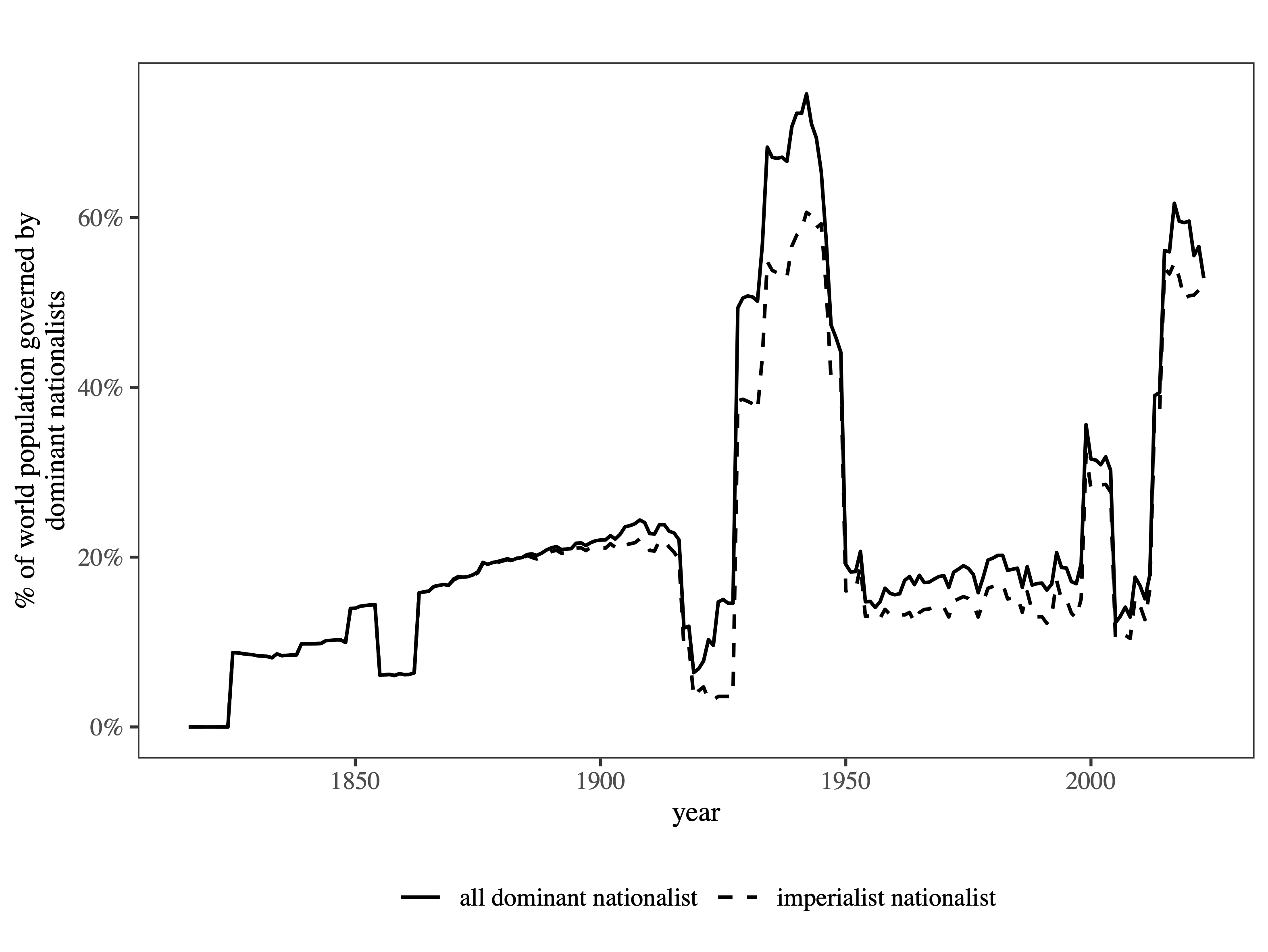
We also estimate a counterfactual democratic trajectory absent the dominant nationalist resurgence since 2008, finding cumulative negative effects consistent with the timing and magnitude of the recent wave of democratic backsliding. Reverse causation, expert-coding bias, and omitted variable bias are addressed through placebo tests, more "objective" democracy indicators, and causal sensitivity analyses.
We conclude that dominant nationalism has emerged as a central driver of democratic erosion across much of the contemporary world. Especially in multiethnic states, where questions of national identity are politically salient, dominant nationalist projects systematically undermine liberal institutions, marginalize minority voices, and entrench authoritarian rule. Efforts to diagnose, prevent, and reverse democratic backsliding must therefore confront dominant nationalism not merely as a companion to populism, but as a fundamental challenge to democratic governance in its own right.
For detailed findings and methodology, please see the full article linked above.