Beyond Congruence: Nationalism, State Power, and the Return of Imperialism
A power-based redefinition of nationalism, with cross-national evidence showing that nationalism and imperialism are compatible ideologies but form an unstable combination, as imperialist nationalist regimes face systematically higher risks of domestic and international destabilization.
Beyond Congruence: Nationalism, State Power, and the Return of Imperialism
An increasing number of the world's most powerful states are governed by leaders whose nationalism extends well beyond the classic goal of national self-determination. Vladimir Putin's vision of a "Russian World," Xi Jinping's civilizational claims over Taiwan and the South China Sea, and Donald Trump's assertions of hemispheric primacy and territorial ambitions toward places such as Canada and Greenland all point to a broader phenomenon: forms of nationalism that seek not merely a nation-state, but dominance over other states and regional spheres of influence.
In our forthcoming article, we argue that these imperialist projects are not deviations from nationalism but expressions of it. More specifically, we show that nationalism and imperialism are not inherently incompatible ideologies. Historically and theoretically, nationalism has often coexisted with imperial ambitions for hierarchy, domination, and expansion. Yet our analysis also demonstrates that this combination is deeply unstable. Imperialist nationalist regimes repeatedly generate dynamics that increase the risk of domestic and international destabilization, including coups, civil war, foreign occupation, and regime collapse.
The article makes three core contributions: a reconceptualization of nationalism, a new typology of nationalist rule, and systematic evidence associating imperialist nationalism with territorial aggression and long-run instability.
Rethinking Nationalism Beyond Nation-State Congruence
The dominant theoretical tradition in nationalism studies, associated most prominently with Ernest Gellner, defines nationalism as the political principle that state boundaries should coincide with national boundaries. On this account, nationalism is fundamentally tied to the rise of the modern nation-state. Empires are treated as relics of a premodern order, gradually displaced by nation-states as industrialization and mass politics transformed the international system.
This framework has been enormously influential, but it struggles to explain a recurring empirical reality: many nationalist movements do not stop at congruence. Instead, they seek authority over minorities within the state, claim territories beyond existing borders, or aspire to dominate neighboring states politically, militarily, or culturally.
Contemporary geopolitics makes this tension clear. Expansionist and hierarchical projects are increasingly articulated through nationalist language rather than dynastic, religious, or explicitly imperial ideologies. Yet much of the existing literature continues to assume that nationalism and imperialism are mutually exclusive categories.
We argue instead that nationalism should be defined more fundamentally as an ideology claiming state power for a nation and, typically, its political unity within that state. Once nationalism is understood in these terms, the apparent contradiction between nationalism and imperialism disappears.
A New Typology of Nationalism
Building on this conceptual shift, we introduce a nested typology consisting of four forms of nationalism.
-
Monistic nationalism corresponds to the classic Gellnerian ideal: one nation aligned with one state, with no competing national communities exercising political authority.
-
Pluralist nationalism accepts institutionalized power-sharing among multiple national communities within the same state. Rather than insisting on complete congruence, it tolerates or endorses multinational political arrangements.
-
Dominant nationalism exceeds congruence internally. Here, one nation claims privileged authority over minority nations within existing state borders.
-
Finally, imperialist nationalism extends dominance outward beyond the state itself. These projects seek either territorial incorporation or hierarchical control over formally independent polities through spheres of influence, civilizational claims, or regional hegemonic ambitions.
The central point is that imperialist nationalism is not an anomaly, but a recurring historical configuration. Earlier scholars such as Carlton Hayes, Walter Sulzbach, and Imanuel Geiss all recognized connections between nationalism and imperial expansion, particularly in the context of "integral" or pan-nationalist movements. What changed historically was not the disappearance of imperial ambitions, but the language used to justify them. Dynastic and religious legitimations gave way to national ones.
This continuity is also visible in geopolitical theory. Carl Schmitt's concept of Grossraum (a sphere-of-influence order organized around a dominant power) captures many of the same dynamics. Such ideas have gained renewed prominence in contemporary American, Russian, and Chinese intellectual debates.
Measuring Imperialist Nationalism
To evaluate these arguments empirically, we draw on the new Dominant Nationalist Movements (DNM) Dataset, which codes political authority structures across 202 sovereign states from 1816 to 2023. The dataset identifies governing movements and classifies whether they articulate dominant or imperialist nationalist claims.
Imperialist nationalist movements are coded based on the combination of two elements: ideological narratives emphasizing civilizational mission, national superiority, historical greatness, or restoration, and outward-directed claims involving territorial expansion or hierarchical regional authority.
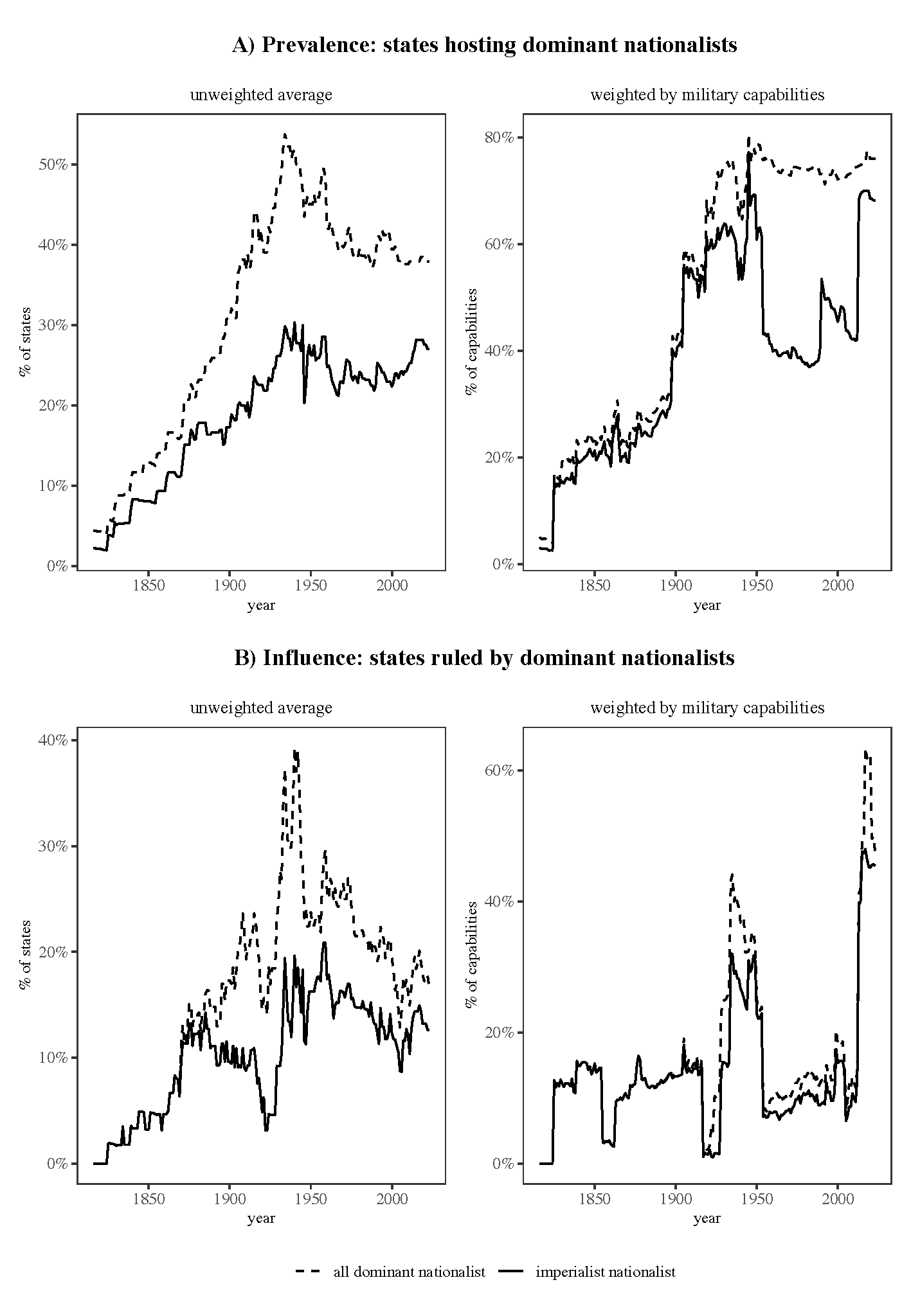
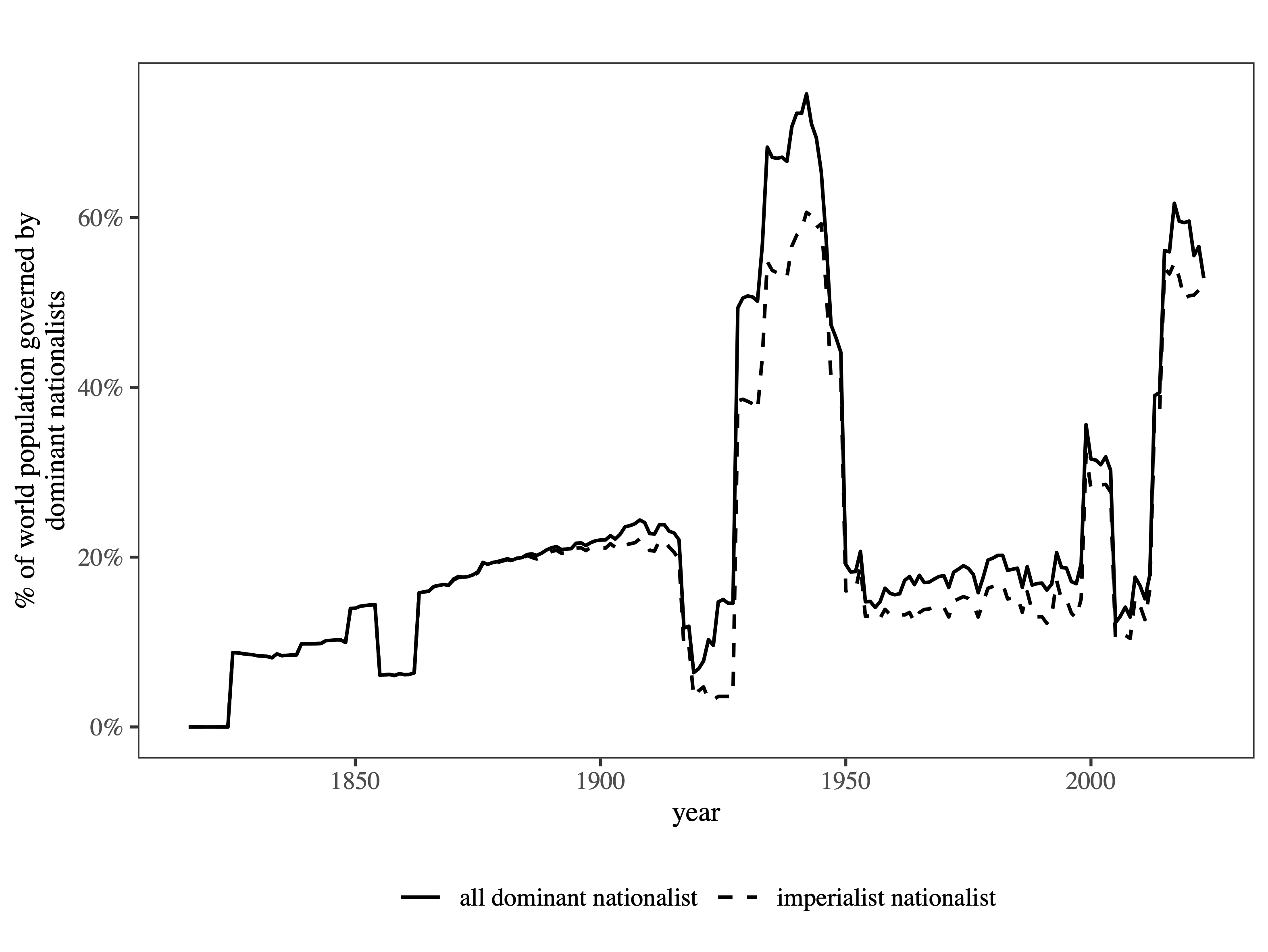
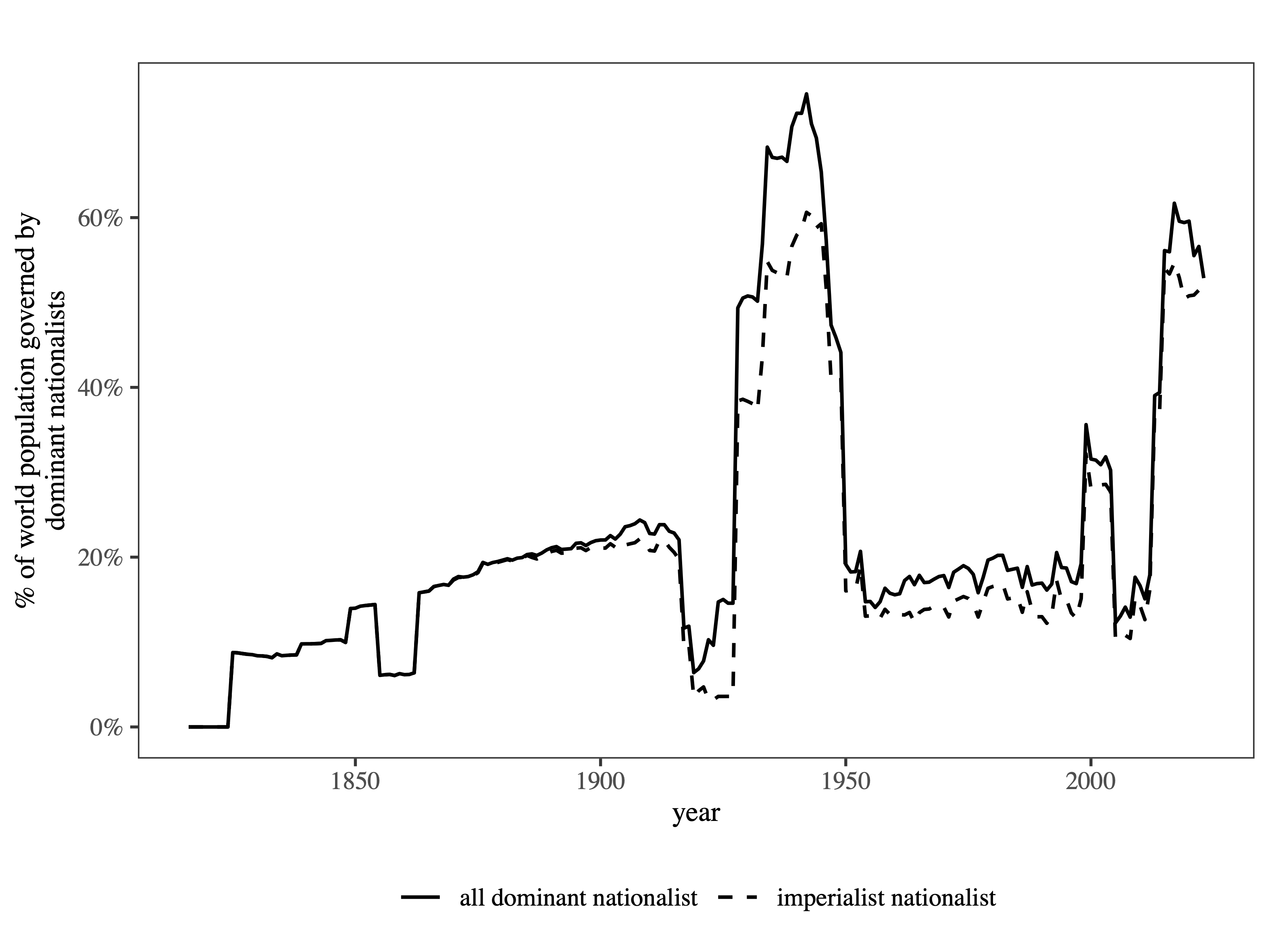
The resulting data reveal several notable patterns (figure 1).
First, imperialist nationalism is not rare, neither historically nor in the contemporary period. It governed roughly one-fifth of states during the era surrounding the two world wars. While it declined during much of the Cold War and immediate post-Cold War period, it has increased again since the 2010s.
Second, the phenomenon of imperialist nationalism is disproportionately concentrated among powerful states. When weighted by military capabilities, dominant and imperialist nationalism become substantially more prevalent. In other words, the states most capable of reshaping international order are also the most likely to embrace nationalist projects that exceed conventional nation-state boundaries.
Nationalism and Territorial Expansion
We then examine whether imperialist nationalism is associated with revisionist foreign policy behavior. Using difference-in-differences models on directed contiguous dyad-years from 1816 to 2023, we find strong evidence that states governed by dominant (and especially imperialist) nationalists are significantly more likely to conquer neighboring territory.
Historical cases illustrate this pattern repeatedly. Germany's trajectory from Völkisch nationalism to Nazism, Russia's evolution from Tsarist imperial nationalism to Putin's "Russian World," Japan's pre-1945 expansionism, and Turkey's contemporary neo-Ottoman discourse all reflect nationalist projects that moved beyond congruence toward hierarchical regional domination.
These findings challenge the widespread assumption that nationalism primarily stabilizes international politics once nation-state congruence is achieved. In many cases, nationalist mobilization instead creates incentives for revisionism and expansion.
The Self-Undermining Logic of Imperialist Nationalism
The article's most consequential finding, however, concerns political stability.
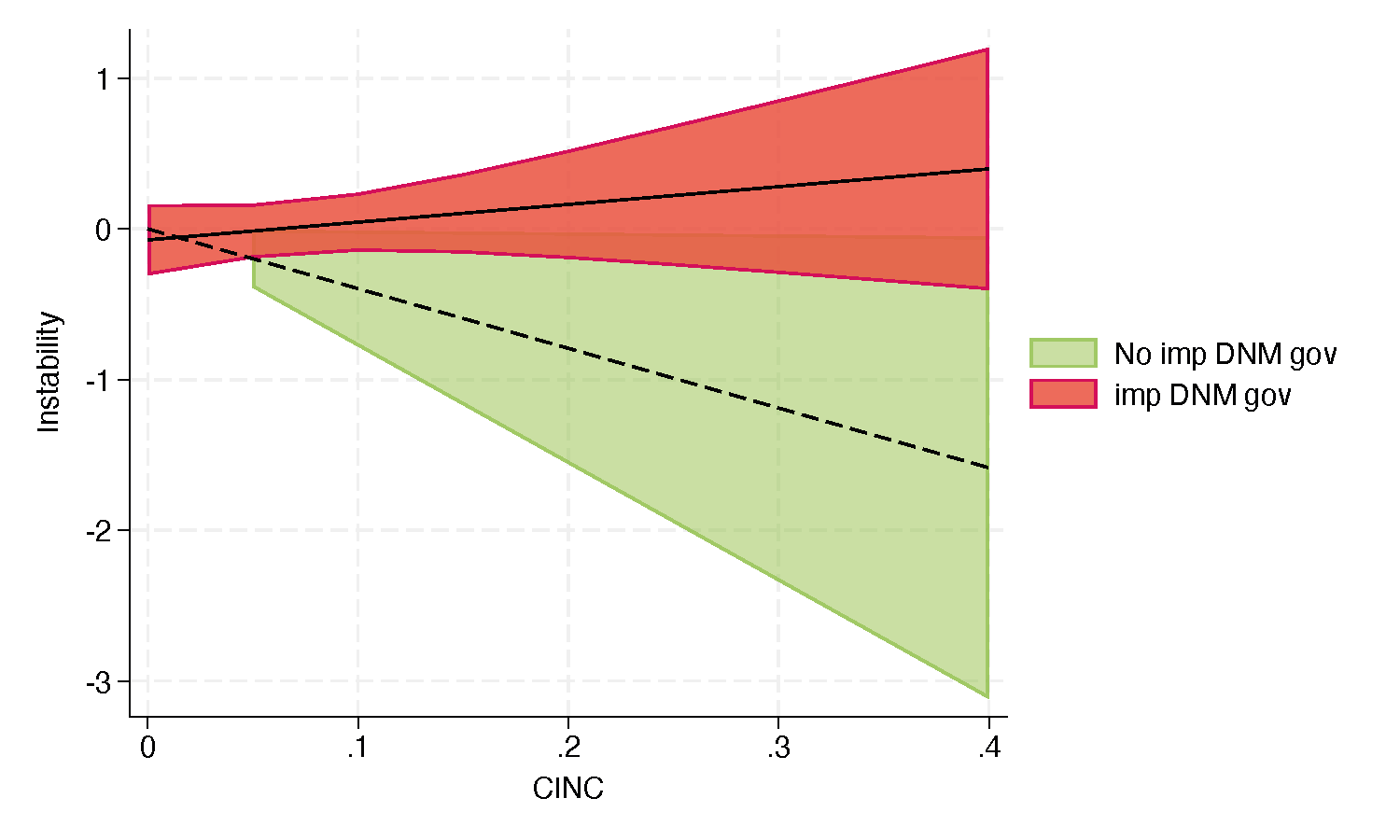
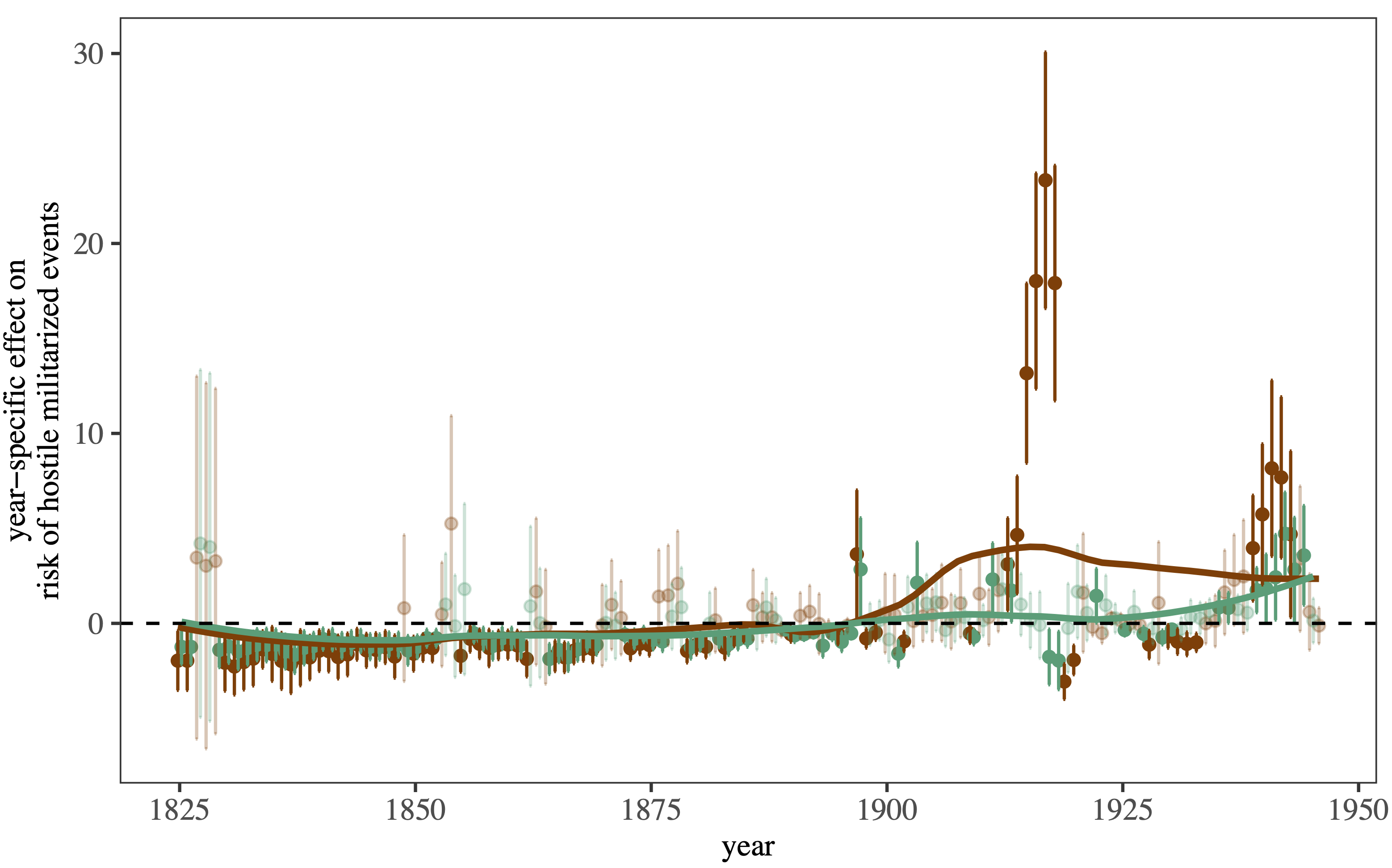
Our country-year models show that imperialist nationalism becomes increasingly destabilizing as state power grows. The interaction between imperialist nationalism and material capabilities strongly predicts regime collapse, coups, foreign occupation, and civil war. This relationship does not appear for non-imperialist forms of dominant nationalism.
This suggests that imperialist nationalism contains a distinct self-undermining dynamic. As these regimes accumulate power, they often pursue increasingly ambitious external projects that generate military overstretch, geopolitical backlash, domestic polarization, or institutional fragmentation.
The historical record repeatedly reflects this pattern. Nazi Germany ended in catastrophic defeat and occupation. The Soviet Union collapsed under the pressures of imperial overstretch and internal contradiction. Yugoslavia disintegrated violently amid competing nationalist projects. In each case, regimes pursuing expansive nationalist visions ultimately proved highly vulnerable to systemic breakdown.
Our argument is therefore that imperialist nationalism is not only dangerous for other states, but also for the regimes that adopt it.
Implications for Contemporary Politics
These findings carry direct implications for understanding current global politics.
The contemporary resurgence of imperialist nationalism suggests that the post-Cold War expectation of an increasingly stable nation-state order may have been overly optimistic. Rather than disappearing, expansionist forms of nationalism appear to be returning, particularly among major powers.
Understanding these projects as coherent ideological formations, rather than as isolated pathologies or irrational deviations, is necessary for both scholars and policymakers. Treating imperialist nationalism as analytically distinct allows us to better identify the conditions under which it emerges, the forms of conflict it produces, and the mechanisms through which it may eventually destabilize itself.
This perspective also suggests caution regarding assumptions about the durability of contemporary revisionist powers. Historically, regimes pursuing expansive nationalist projects have often appeared formidable in the short term while simultaneously generating vulnerabilities that accumulate over time.
The broader implication is that nationalism should not be understood solely as an ideology of self-determination. Under certain conditions, it also becomes an ideology of hierarchy and domination. Recognizing this broader repertoire is necessary for understanding both the persistence of imperial politics and the instability that frequently accompanies it.
For detailed findings and methodology, please see the full article linked above.