Minorities overlooked: Group-based power-sharing and the exclusion-amid-inclusion dilemma
New data on constitutional power-sharing and a cross-national quantitative analysis of how different types of power-sharing arrangements may include some ethnic minorities while further marginalizing others.
** Does power-sharing empower some minorities at the expense of further marginalizing others? **
In this article in International Political Science Review, I provide global evidence on this question. I find that the smallest and most vulnerable minorities may indeed be further marginalized due to the inclusion of larger minorities.
Ethnic power-sharing is often as exclusionary as it is inclusive. As it relies on a fixed list of groups who are to be empowered, it necessarily treats different ethnic groups unequally. For example, it does so by giving them preferential access to government positions and veto rights. However, how does it affect the political outcomes of micro-minorities, who are the numerically most vulnerable groups in a society? Existing case-based evidence indicates that inter-ethnic peace is often "bought" at the price of further marginalizing micro-minorities – in the most drastic cases, by institutionally excluding them from access to government office altogether. A prominent example is the Sejdić and Finci v. Bosnia and Herzegovina case, which drew attention to the institutionalized discrimination against Bosnian citizens of Jewish or Roma background. Whereas Bosnia's constituent groups, the Bosniaks, Serbs, and Croats share power among themselves, Jewish and Roma citizens are a priori excluded from access to Presidial office and to the upper house.
Are these exclusionary tendencies part of a wider, systematic phenomenon, whereby ethnic power-sharing increases discrimination against micro-minorities? And would micro-minorities fare better under alternative, more liberal power-sharing institutions?
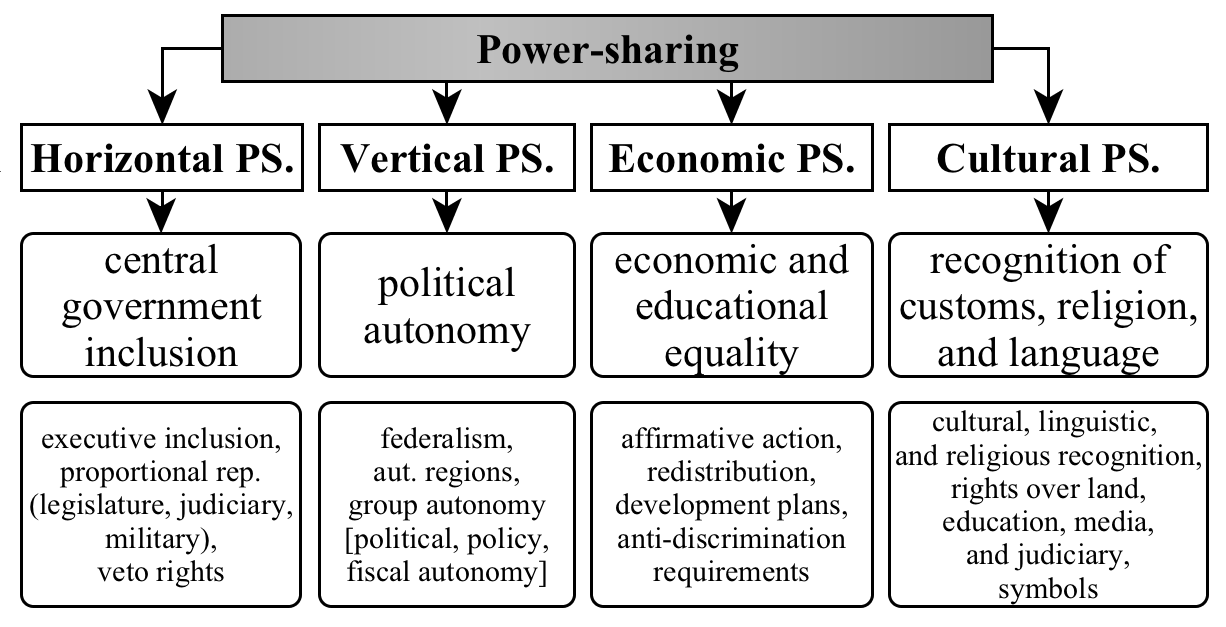
In this article, I argue that institutional "engineers" seeking to pacify divided places face a significant trade-off. On the one hand, ethnic (or corporate) power-sharing institutions as in Bosnia decrease inter-ethnic inequality by strongly empowering minorities "who make it onto the list" of accommodated groups. In the case of Bosnia, this applies to the Serb and Croat minorities, who share power with the Bosniaks in the Presidency and in the Upper House. This brings their political status closer to the one of the majority group. However, at the same time, these institutions often "leave behind" micro-minorities, such as Bosnia's Jews or Roma, either by institutionally excluding them in the first place or by failing to empower them effectively.
On the other hand, liberal power-sharing has more equal, but weaker, effects across minority groups. It typically relies on inclusive institutions that are not ethnically-differentiated but nevertheless encourage the inclusion of minorities. For instance, post-Apartheid South Africa did so by on an interim basis giving all parties with a vote share of at least 5% the right to ministerial posts. Similarly, post-Saddam Iraq established an interim Presidential Council, whose election required a parliamentary supermajority. While not discriminating against micro-minorities, liberal power-sharing only indirectly encourages ethnic inclusiveness and thereby exerts weaker overall effects. Liberal power-sharing, though avoiding similar discrimination, is not equally well-suited to close the gap between the majority/plurality group and the overall minority population effectively.
In the article, I make use of a new dataset I collected, the Constitutional Power-Sharing dataset to test these claims cross-nationally. This provides me with group-based data on corporate and liberal power-sharing institutions in more than 100 countries for the time period between 1946 and 2013.
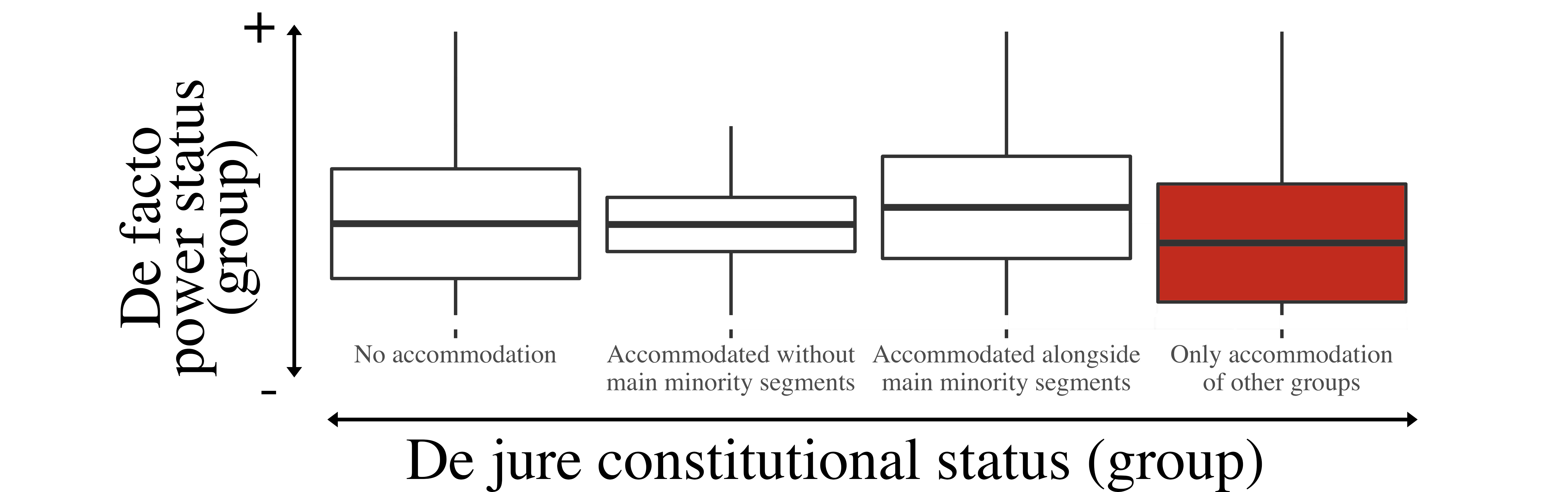
Overall, my findings are in accordance with my expectations. They indicate that the situation of Jews and Roma in Bosnia is not an isolated case. Corporate power-sharing often excludes micro-minorities from its list of included groups in the first place. Even where its inclusive provisions extend to micro-minorities, they often do not result in tangible gains of de-facto political influence for them. Most problematically, I also find tentative evidence for 'crowding out' effects: the gains of larger minorities translate into lower political attainments for micro-minorities, who are 'crowded out' from office. Conversely, I find that liberal power-sharing indeed results in higher inclusiveness across minority types, though it does so more weakly than the more widely-used corporate type.